
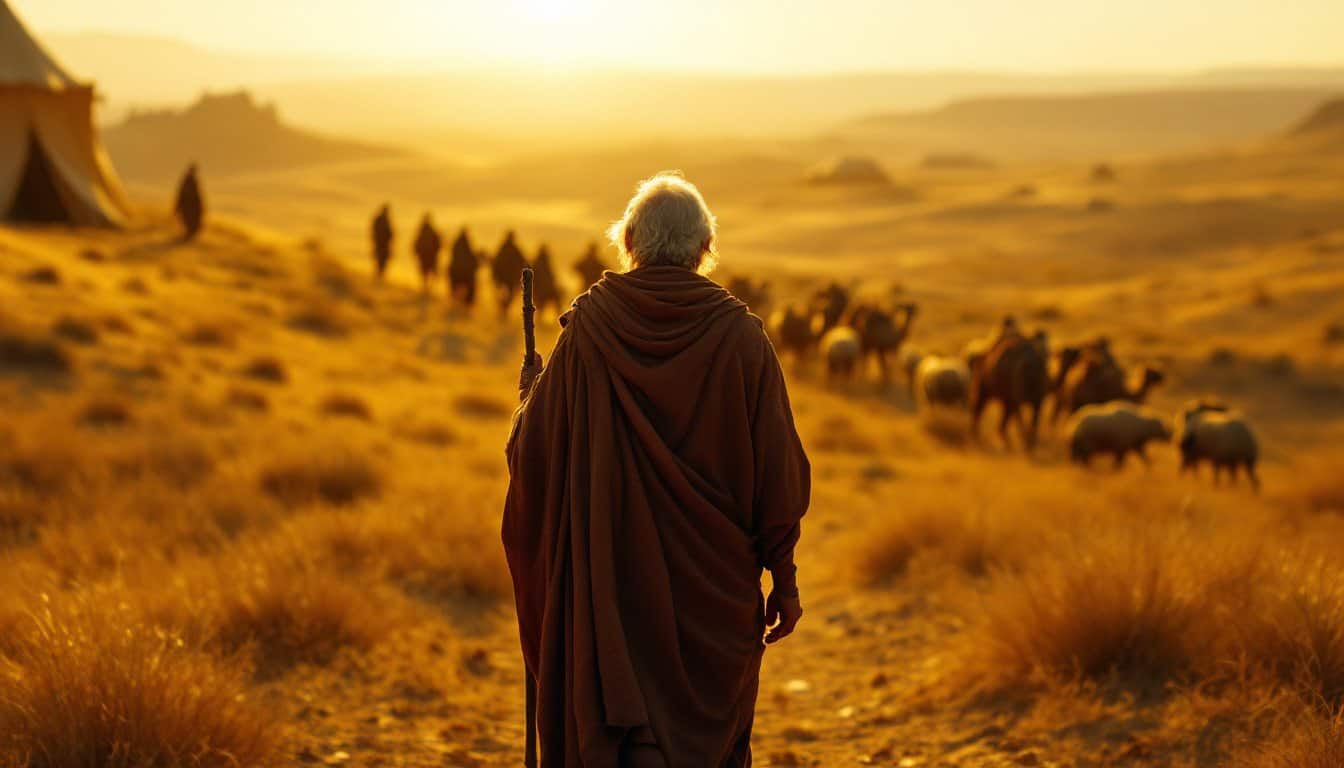
Who founded Judaism? Was it Avraham, Moshe, or the rabbis of antiquity? How long has it existed, and what do we know about its beginnings? These questions sound simple, but the answer involves the entire history of a people. Here is a complete overview: what the Torah and the Talmud tell us, the dates given by tradition, what historians say, and why, for Judaism, its origin is not merely an event of the past.
According to Jewish tradition, Judaism begins with Avraham (Abraham), a man born in Mesopotamia who, in the midst of an idolatrous world, recognized that there is one single G-d, the Creator of all things, and who was commanded to set out for the land of Canaan (Bereshit [Genesis] 12:1-3). This faith was passed on to his son Yitzchak (Isaac) and to his grandson Yaakov (Jacob), also called Israel, whose twelve sons became the twelve tribes. Their descendants, reduced to slavery in Egypt, were freed under the leadership of Moshe (Moses) and received the Torah at Mount Sinai, seven weeks after the Exodus from Egypt (Shemot [Exodus] 19-20). According to the traditional reckoning, Avraham was born in the year 1948 from Creation (around 1812 BCE) and the Torah was given in the year 2448 (around 1312 BCE). Avraham is therefore the father of the people and of the faith; Sinai is the moment when this people became a nation bound to G-d by a Law.
Before Avraham: a world that had forgotten
To understand what Avraham brought, we first need to see where he started from. The Torah does not present Judaism as a human invention that appeared out of nowhere. It begins with the creation of the world and of man, Adam, who knew his Creator. The book of Bereshit (Genesis) then recounts ten generations from Adam to Noach (Noah), and ten more generations from Noach to Avraham. The Ethics of the Fathers highlight this detail: “Ten generations from Noach to Avraham, to make known how patient He is, for all these generations angered Him, until Avraham our father came and received the reward of them all” (Pirkei Avot 5:2).
The Rambam (Maimonides, 12th century) describes this period at the beginning of his Laws of Idolatry (Mishneh Torah, Hilkhot Avoda Zara 1:1-2). In the days of Enosh, Adam’s grandson, people made a serious error of reasoning. They said to themselves: since G-d created the stars to govern the world and gave them honor, it is fitting to honor them as well. The intention was to pay homage to the Creator through His servants. But over time, the Creator was forgotten, and people served only the stars, and then statues. “The glorious and awesome Name was forgotten from the mouths of all beings,” writes the Rambam, except for a few individuals such as Chanokh (Enoch), Metushelach (Methuselah), Noach, Shem and Ever (Hilkhot Avoda Zara 1:2).
This account matters: for Jewish tradition, faith in one G-d was not born with Avraham; it is humanity’s original truth. Avraham did not invent it; he rediscovered it and gave it back to a world that had lost it.
Avraham, the first Hebrew
A child in the house of an idol merchant
Avraham, first called Avram, was born in Ur Kasdim, “Ur of the Chaldeans”, in Mesopotamia (Bereshit 11:27-28). His father, Terach, left Ur with his family to go to Canaan, but stopped along the way and settled in Haran, in what is now the border region of Syria and Turkey (Bereshit 11:31). The book of Yehoshua (Joshua) states it plainly: “Your fathers dwelt of old beyond the River, Terach, the father of Avraham and the father of Nachor, and they served other gods. And I took your father Avraham from the other side of the River” (Yehoshua 24:2-3).
The Midrash (Bereshit Rabba 38:13) tells a story that has become famous. Terach made and sold idols. One day, he left his son to mind the shop. Avram smashed all the statues with a stick, except the largest one, in whose hand he placed the stick. When his father returned in a rage, Avram explained that the idols had quarreled over an offering and that the biggest one had broken the others. “Are you mocking me? They can’t do anything!” cried Terach. “Let your ears hear what your mouth is saying,” his son replied. Terach then handed him over to King Nimrod, who had him thrown into a blazing furnace; Avram came out alive.
A discovery through reflection
How did Avraham discover G-d? The Talmud reports that he “recognized his Creator at the age of three” (Nedarim 32a). The Rambam, for his part, describes a long search: “From the time he was weaned, while still a small child, he began to reflect day and night and wondered: how is it possible that the celestial sphere turns continuously without anyone turning it?” He had neither teacher nor anyone to instruct him, and he lived among idolaters. “At the age of forty, Avraham recognized his Creator” (Hilkhot Avoda Zara 1:3). The two traditions complement each other: the quest begins in childhood and reaches its goal in maturity.
The Midrash illustrates this quest with a parable (Bereshit Rabba 39:1). A man was traveling and saw a palace in flames. He said to himself: “Is it possible that this palace has no master?” The owner of the palace then appeared to him and said: “I am the master of the palace.” In the same way, Avraham, seeing a magnificent world given over to disorder, wondered whether it had no master; and it was then that G-d revealed Himself to him. Avraham’s faith is not blind belief: it is born of a question.
Lekh lekha: the call to set out
The founding moment comes when Avraham is seventy-five years old. G-d says to him: “Go for yourself, from your land, from your birthplace and from your father’s house, to the land that I will show you. I will make you a great nation, I will bless you, I will make your name great, and you shall be a blessing. […] And through you all the families of the earth shall be blessed” (Bereshit 12:1-3). These two Hebrew words, lech lecha, give their name to the entire section of the Torah.
Avraham sets out with his wife Sarah, his nephew Lot, and “the souls they had made in Haran” (Bereshit 12:5). Rashi explains, following the Midrash, that these were the people Avraham and Sarah had brought close to the faith: Avraham taught the men, Sarah the women. From the very start, Judaism is not a private illumination; it is a teaching that is handed on.
Why is he called “the Hebrew”?
Avraham is the first figure in the Bible to be called ivri, “Hebrew” (Bereshit 14:13). The Midrash offers three explanations of this name (Bereshit Rabba 42:8). According to the first, it comes from ever, “the other side”: the whole world stood on one side, and Avraham on the other. According to the second, he was a descendant of Ever, the great-grandson of Shem. According to the third, he came from the other bank of the river, the Euphrates. The first reading has become a definition of Jewish identity: having the courage to stand alone against everyone’s opinion when the truth demands it.
The covenant and the trials
The relationship between G-d and Avraham is sealed by a covenant, the brit. First comes the “Covenant between the Pieces” (Bereshit 15), in which G-d promises him the land of Canaan and tells him that his descendants will be strangers and enslaved in a land not their own for four hundred years, before leaving it “with great wealth” (Bereshit 15:13-14). Then comes the covenant of circumcision, at the age of ninety-nine, together with a change of name: Avram becomes Avraham, “father of a multitude of nations” (Bereshit 17:5).
The Sages teach that Avraham was tested ten times and withstood every test (Pirkei Avot 5:3). The last and most famous is the akeda, the binding of Yitzchak on Mount Moriah (Bereshit 22), where Avraham shows he is ready to give everything, and where G-d stays his hand. The Talmud adds that Avraham already observed the entire Torah before it was given (Yoma 28b), based on the verse “because Avraham listened to My voice and kept My charge, My commandments, My statutes and My teachings” (Bereshit 26:5).
Finally, the Torah states why Avraham was chosen: “For I have singled him out so that he will command his children and his household after him to keep the way of the L-rd, doing righteousness and justice” (Bereshit 18:19). Avraham’s election is not a privilege: it is a mission of transmission, centered on justice and kindness. The Rambam sums this up by saying that Avraham “began to call out in a great voice to the whole world and to make known to it that there is one G-d for the entire universe,” going from town to town until he had gathered thousands of people (Hilkhot Avoda Zara 1:3).
From a family to a people: Yitzchak, Yaakov and Egypt
Avraham has a son by Sarah, Yitzchak, who in turn receives the covenant. Yitzchak has two sons, Esav (Esau) and Yaakov; it is Yaakov who carries it on. After a night of wrestling with an angel, he receives a new name: “Your name shall no longer be Yaakov, but Israel, for you have striven with the divine and with men, and you have prevailed” (Bereshit 32:29). This is the origin of the expression Bnei Yisrael, “the children of Israel”, which designates the Jewish people throughout the Bible.
Avraham, Yitzchak and Yaakov are called the avot, the Patriarchs. Together with their wives, Sarah, Rivka (Rebecca), Rachel and Leah, the Matriarchs, they form the first generation of the people. The Talmud credits them with instituting the three daily prayers: Avraham the morning prayer, Yitzchak the afternoon prayer, Yaakov the evening prayer (Berakhot 26b). To this day, the Amida, the central prayer recited three times a day, opens with the words “G-d of Avraham, G-d of Yitzchak and G-d of Yaakov”.
Yaakov has twelve sons, the ancestors of the twelve tribes. Because of a famine, the whole family, seventy people, goes down to Egypt, where Yosef (Joseph), one of the sons, has become viceroy (Bereshit 46:27). After that generation dies, a new Pharaoh enslaves the Hebrews, who have grown numerous (Shemot 1:8-14). It is in this crucible of slavery, the commentators say, that the family becomes a people. The Torah indeed compares Egypt to an “iron furnace” (Devarim [Deuteronomy] 4:20): suffering forged the people’s identity.
Tradition calculates that the stay in Egypt lasted 210 years; the “four hundred years” announced to Avraham are counted from the birth of Yitzchak (Rashi on Bereshit 15:13 and on Shemot 12:40).
Moshe and the Exodus from Egypt
Moshe was born in this time of persecution, when Pharaoh had ordered that Hebrew baby boys be thrown into the Nile. Saved by his mother and his sister, raised at court by Pharaoh’s daughter, he took the side of his brothers, had to flee, and became a shepherd in the desert of Midian. It was there, at the burning bush, that G-d revealed Himself to him and sent him to free his people (Shemot 3). When Moshe asked what name to give to this G-d, he was told: “Ehyeh asher ehyeh”, “I will be what I will be” (Shemot 3:14).
Then came the ten plagues, followed by the Exodus from Egypt on the 15th of Nissan, which Jews commemorate every year at Pesach (Passover). The Torah presents this event as the foundation of the relationship between G-d and Israel. The first of the Ten Commandments does not say “I am the L-rd who created heaven and earth”, but “I am the L-rd your G-d, who brought you out of the land of Egypt, out of the house of slavery” (Shemot 20:2). G-d introduces Himself to Israel first and foremost as a liberator.
Moshe’s role must be properly understood, however. For Judaism, he is not the “founder” of a religion in the sense in which founders are spoken of elsewhere. He is the greatest of the prophets (Devarim 34:10) and the one who transmitted the Torah, but Judaism does not bear his name and does not make him an object of worship. The Torah even specifies that no one knows where his grave is (Devarim 34:6). He is called Moshe Rabbenu, “Moshe our teacher”: the title of a teacher.

Sinai: the birth of a nation
What the Torah tells us
“In the third month after the children of Israel went out of the land of Egypt, on that very day, they came to the desert of Sinai” (Shemot 19:1). The people camp at the foot of the mountain. G-d offers them a covenant: “If you will listen to My voice and keep My covenant, you shall be My treasure among all the peoples […]; you shall be for Me a kingdom of priests and a holy nation” (Shemot 19:5-6). The people answer with one voice: “All that the L-rd has spoken, we will do” (Shemot 19:8).
After three days of preparation, amid thunder, lightning and the sound of the shofar, G-d proclaims the Ten Utterances before the whole people (Shemot 20:1-14). Moshe then goes up the mountain for forty days to receive the Tablets of the Law and the whole body of teaching. When the covenant is concluded, the people utter the phrase that sums up the spirit of Judaism: “Na’aseh venishma”, “we will do and we will understand” (Shemot 24:7). Commitment comes before understanding, but does not replace it.
When was the Torah given?
The Talmud discusses the exact date (Shabbat 86b). According to the view of the Sages, the Torah was given on the 6th of the month of Sivan; according to Rabbi Yossi, on the 7th; all agree that it was on Shabbat. The festival of Shavuot is set on the fiftieth day after Pesach, today the 6th of Sivan, and the liturgy calls it “the time of the giving of our Torah”. Several halakhic authorities point out, however, that the halakha follows Rabbi Yossi, and the commentators have offered various explanations for this one-day difference. According to the traditional chronology of Seder Olam, it was in the year 2448 from Creation, around 1312 BCE. Every year at Shavuot, Jews do not celebrate a distant memory but the renewal of this commitment.
The Written Torah and the Oral Torah
At Sinai, according to tradition, Moshe did not receive only a text. He received the Written Torah, the five books (Bereshit, Shemot, Vayikra, Bamidbar, Devarim: Genesis, Exodus, Leviticus, Numbers, Deuteronomy), and the Oral Torah, that is, the explanation of these texts and the way to apply them. This is how the Ethics of the Fathers opens: “Moshe received the Torah from Sinai and handed it down to Yehoshua, Yehoshua to the Elders, the Elders to the Prophets, and the Prophets handed it down to the Men of the Great Assembly” (Pirkei Avot 1:1).
The Rambam, in the introduction to his Mishneh Torah, traces this chain generation by generation, down to Rav Ashi, who compiled the Babylonian Talmud. This continuity is essential to understanding Judaism: the Mishna (put into writing around 200 CE) and the Talmud (around 500 CE) are not, for tradition, new inventions, but the written record of an oral teaching received at Sinai.
Why Sinai is at the heart of Jewish faith
The great Jewish thinkers have stressed one particular feature of this event: it was experienced by an entire people, not by a single individual. The Torah itself invokes it: “Ask now of the days that are past […]: has any people ever heard the voice of G-d speaking out of the midst of the fire, as you have heard, and lived?” (Devarim 4:32-33).
The Rambam makes this the foundation of faith in the prophecy of Moshe. The Israelites, he writes, did not believe in Moshe because of the miracles he performed, since a miracle can leave room for doubt; they believed because at Sinai “our eyes saw, and not a stranger’s, our ears heard, and not another’s” (Hilkhot Yesodei HaTorah 8:1). Likewise, in the Kuzari by Rabbi Yehuda Halevi (12th century), when the king of the Khazars asks the Jewish sage what he believes in, the sage does not begin with philosophical proofs. He answers that he believes in the G-d of Avraham, Yitzchak and Israel, who brought the children of Israel out of Egypt and gave them the Torah (Kuzari I:11), and then explains that this account, attested by an entire people, is the starting point of his faith (Kuzari I:25).
Avraham or Sinai: where does Judaism really begin?
Two answers are often heard: “Judaism begins with Avraham” or “Judaism begins at Sinai”. Both are true, on different levels.
With Avraham begin the people and the faith. The Talmud divides the history of the world into three periods of two thousand years: two thousand years of tohu, “chaos”, then two thousand years of Torah, then two thousand years of the days of the Messiah. And it specifies that the two thousand years of Torah begin when Avraham, at the age of fifty-two, starts bringing people close to the faith in Haran (Avoda Zara 9a). For the Talmud, then, the era of Torah does not begin at Sinai but with the teaching of Avraham.
At Sinai begins the nation bound by a Law. The Patriarchs were a family carrying a faith; at Sinai, an entire people committed itself to living by the mitzvot (the commandments of the Torah). This is why the Talmud teaches that before the giving of the Torah, the Israelites entered the covenant the way one enters Judaism through conversion: circumcision, immersion and an offering (Keritot 9a). Every Jew, even one born Jewish, in a sense descends from that moment.
There is also a third stage: the name. The word “Jew” comes from Yehuda (Judah), Yaakov’s fourth son, whose tribe gave its name to the kingdom of Judah and later to Judea. After the Babylonian exile (6th century BCE), members of all the tribes came to be called Yehudim. The book of Esther calls Mordechai, who was from the tribe of Binyamin (Benjamin), “a Jewish man” (Esther 2:5). As for the word “Judaism”, it first appears in Greek, Ioudaismos, in the Second Book of Maccabees (2 Maccabees 2:21), written around the end of the 2nd century BCE, to describe the Jewish way of life in the face of Hellenism. The word is recent; the reality it describes is far older.
What historians and archaeology say
Jewish tradition dates Avraham and Moshe precisely, on the basis of the genealogies of the Bible and of Seder Olam, a chronicle attributed to the Sage Rabbi Yossi ben Chalafta (2nd century). Historians work with other tools, and it is only honest to present both approaches.
Outside the Bible, there is no ancient document that mentions Avraham or Moshe by name. This is hardly surprising: the sources of that era speak mainly of kings and empires, and rarely of the head of a nomadic family or of a group of foreign slaves. Many historians place the world of the patriarchal narratives in the Near East of the 2nd millennium BCE, and observe that names, customs and places mentioned in Bereshit fit that region. Opinions differ widely on the dating and historicity of these narratives, and research on these questions remains hotly debated.
From the end of the 2nd millennium onward, on the other hand, the evidence becomes clear:
- The Merneptah Stele, inscribed around 1208 BCE for Pharaoh Merneptah, mentions a people called “Israel” in Canaan. It is the oldest known mention of that name outside the Bible.
- The Tel Dan Stele (9th century BCE) mentions the “House of David”, the royal dynasty of Judah.
- The Mesha Stele, set up by Mesha, king of Moab (around 840 BCE), mentions Omri, king of Israel, and the divine Name of Israel.
- The Ketef Hinnom amulets, two small silver scrolls discovered in Jerusalem and dated to the end of the First Temple period, bear a version of the Priestly Blessing (Bamidbar [Numbers] 6:24-26). They are considered the oldest known witness to a biblical text.
For the believer, this is not the heart of the matter. Jewish tradition does not rest on an archaeological discovery but on an unbroken transmission, from parents to children, ever since the event at Sinai. This is what the Torah asks: “Remember the days of old, consider the years of generation after generation; ask your father and he will tell you, your elders and they will relate it to you” (Devarim 32:7).
What Rav Raphaël Benizri teaches
Rav Raphaël Benizri has devoted many lectures to the figure of Avraham, in particular in his series on the parasha of Lech Lecha and in his study of chapter 39 of Bereshit Rabba. Here are the main ideas, faithfully summarized.
Ivri: the man from the other side
In Bereshit Raba 39, part 1, the Rav takes up the Midrash according to which Avraham is called ivri because the whole world is on one side and he is on the other. He gives idolatry a deeper meaning than the worship of statues: a school of thought that has become frozen and static, a “stereotype that has been left to grow old”, is already a form of idolatry. Terach, he explains, sold idols, that is, ideas: he prescribed to each person the school of thought that suited him, the way one prescribes a remedy. Avraham belonged to a society in which philosophy reigned supreme, but which never arrived at the vision of a G-d beyond logical thought.
For the Rav, lech lecha is not, however, a repudiation of everything that came before. It is not a matter of denying or disparaging what one has received, but of looking at it again from a new angle, of “dusting it off”. And faith, he insists, is not a grace received from outside: it is the fruit of searching and of a quest.
Haran, or the comfort of exile
In the same lecture, the Rav dwells on the city of Haran, where the family had settled. It was, he says, one of the most developed cities of its time, intellectually, in its crafts and economically; there one could practice one’s faith and even teach it freely. Why leave, then? Because G-d asks Avraham not to settle into this comfort: to carry a universal message, one first needs an existence of one’s own and a land. The Rav quotes the Midrash that compares Avraham to a sealed flask of perfume set down in a corner: as long as it is not moved, its fragrance does not spread. Leaving is not a loss; it is the condition for his influence to radiate outward.
Avraham’s three battles
In Lech Lecha: Avraham’s journey, the Rav asks what Avraham did between the age of three, when his search began according to the Midrash, and the age of seventy-five, when he was called. His answer: he waged a struggle against three forms of deviation, those of the three great generations that came before him. The generation of Enosh, Adam’s grandson, clung to the many manifestations of the divine, in nature and in ideas, instead of tracing them back to their single source. The generation of the Flood abandoned man to his desires, until “the earth was filled with violence”. The generation of the dispersion, that of Nimrod and the Tower of Babel, separated the spiritual from the material and sought to make all of humanity uniform “under a single flag, a single tower, a single city”. These three temptations, the Rav says, were common then, they are common today, and they will be tomorrow.
He adds that “the souls made in Haran” are all the people Avraham had drawn in his wake during his struggle against Nimrod’s decree. From the very start, Avraham’s departure is a collective movement.
A faith in motion
In Lech Lecha: faith in motion, the Rav points out that Avraham sets out without knowing where he is going, toward “the land that I will show you”. The danger, he explains, is not doubt but the comfort of settled ideas: clinging at all costs to one’s patterns and prejudices shuts off any possibility of teshuva (return) and therefore of revelation. He also recalls that Avraham did not discover everything on his own: before him there were the academies of Shem and Ever, where Avraham, Yitzchak and Yaakov studied. And he cites the teaching that history truly begins with Avraham, at the start of the two thousand years of Torah: Avraham is the one who dared to tear down all the frozen ideas of his time.
Sinai, the festival of oaths
In Shavuot: the festival of oaths, the Rav notes that the festival of the giving of the Torah is called neither “the festival of the Torah” nor “the festival of first fruits”, but Shavuot, “weeks”, a word from the same root as shevua, an oath. Two oaths answer each other on that day: G-d’s, who pledges never to exchange this people for another, and Israel’s, who pledges to remain bound to its Creator through the Torah. In Lech Lecha: Avraham’s journey, he also notes that the place where G-d first appears to Avraham in Canaan, Shechem, is the very place where the people, on entering the land, would renew the covenant of Sinai with an oath, between Mount Gerizim and Mount Ebal. The story of Avraham and the story of Sinai thus meet on the same land.
Common misconceptions about the origins of Judaism
“Moses founded Judaism.” Not exactly. Moshe is the greatest of the prophets and the one through whom the Torah was transmitted, but the people and the faith existed before him, from Avraham onward. Judaism does not bear Moshe’s name and offers him no worship.
“Judaism is the religion of the Old Testament.” The expression “Old Testament” is a Christian one. Jews speak of the Tanakh, an acronym of Torah (the five books), Nevi’im (the Prophets) and Ketuvim (the Writings). Above all, Judaism has never lived by that text alone: it reads it through the Oral Torah, the Mishna and the Talmud, which give it its meaning and its application.
“Rabbinic Judaism is a late invention.” Historians observe that the present form of Judaism, centered on the synagogue, prayer and study, developed mainly after the destruction of the Second Temple in 70 CE. But for tradition, the Sages did not invent a new religion: they put into writing and organized an oral teaching handed down since Sinai (Pirkei Avot 1:1), so that it would survive exile.
“Avraham invented monotheism.” Jewish tradition says rather that he rediscovered it: Adam, Chanokh, Noach, Shem and Ever knew the Creator (Rambam, Hilkhot Avoda Zara 1:1-2). What is new with Avraham is that he was not content to believe: he taught, he gathered people, and he founded a family charged with passing on that faith.
“Judaism is a religion like any other.” Judaism is at once a people, a faith and a Law. One enters it by birth or by conversion, not merely by subscribing to a creed. This is why its origins are told as the story of a family that became a nation.
Frequently asked questions about the origins of Judaism
How old is Judaism?
According to tradition, about 3,800 years if one counts from the birth of Avraham (the year 1948 from Creation, around 1812 BCE), and about 3,300 years if one counts from the giving of the Torah at Sinai (the year 2448, around 1312 BCE). The Jewish year 5787, which began on Rosh Hashana in September 2026, is counted from the creation of the world according to tradition.
Who founded Judaism?
Judaism has no “founder” in the usual sense. Avraham is the first Patriarch, the father of the people and the first to teach faith in one G-d. Moshe is the prophet through whom the Torah was given. But for tradition, the author of the Torah is G-d Himself, and the people came into being through a covenant with Him.
Where did Judaism originate?
Avraham was born in Ur Kasdim, in Mesopotamia (in present-day Iraq), then settled in Haran before leaving for Canaan, the future Land of Israel. The people took shape in Egypt, received the Torah in the Sinai desert, and then entered the Land of Israel under the leadership of Yehoshua.
Is Judaism the oldest monotheistic religion?
It is the oldest of the monotheistic religions still practiced today. Christianity and Islam both recognize Avraham as a founding figure and refer to the narratives of the Torah. For Jewish tradition, faith in one G-d goes back even to Adam; Avraham rediscovered it and passed it on.
Why are Jews called “Hebrews”, “Israelites” and “Jews”?
“Hebrew” (ivri) is the name given to Avraham (Bereshit 14:13). “Israelites” comes from Israel, Yaakov’s second name (Bereshit 32:29). “Jew” comes from Yehuda, the tribe that gave its name to the kingdom of Judah; the term became widespread after the Babylonian exile (Esther 2:5).
What exactly happened at Mount Sinai?
Seven weeks after the Exodus from Egypt, the people of Israel gathered at the foot of Mount Sinai. There G-d proclaimed the Ten Utterances before everyone (Shemot 20), and Moshe received the Tablets of the Law along with the whole of the Torah, written and oral. The people committed themselves with the words “we will do and we will understand” (Shemot 24:7). This event is celebrated every year on Shavuot.
Is there archaeological evidence for the biblical story?
There is no external mention of Avraham or Moshe, but the name Israel already appears on the Merneptah Stele (around 1208 BCE), the House of David on the Tel Dan Stele, and the oldest known witness to a biblical text is found on the Ketef Hinnom amulets. Debates among historians remain numerous; Jewish faith, for its part, rests on a continuous transmission from generation to generation.
Further reading
Judaism begins with a departure: “Go for yourself”. Avraham leaves what he knows for a land he cannot yet see; his descendants leave Egypt for a desert where they will receive the Torah. Each generation is invited, in its own way, to travel that road again.
- Lech Lecha: Avraham’s journey
- Lech Lecha: faith in motion
- Bereshit Raba 39, part 1: Lech Lecha
- The 3 Patriarchs: Avraham, Yitzchak and Yaakov
- Shavuot: the festival of oaths
- Shavuot: the giving of the Torah and the book of Ruth
- What is the Torah?
- The Ten Commandments: text, meaning and place in Judaism
- Who is a Jew? And how does one become Jewish?
- Glossary of Hebrew terms in Judaism
Sources and references
- Bereshit (Genesis) 11:27-32; 12:1-5; 14:13; 15:13-14; 17:5; 18:19; 22; 26:5; 32:29; 46:27
- Shemot (Exodus) 1:8-14; 3; 3:14; 12:40; 19:1-8; 20:1-14; 24:7
- Bamidbar (Numbers) 6:24-26
- Devarim (Deuteronomy) 4:20; 4:32-33; 32:7; 34:6; 34:10
- Yehoshua (Joshua) 24:2-3
- Esther 2:5
- Pirkei Avot 1:1; 5:2; 5:3
- Babylonian Talmud, Nedarim 32a (Avraham recognizes his Creator at the age of three)
- Babylonian Talmud, Avoda Zara 9a (the two thousand years of Torah begin with Avraham in Haran)
- Babylonian Talmud, Yoma 28b (Avraham observed the entire Torah)
- Babylonian Talmud, Berakhot 26b (the Patriarchs instituted the three prayers)
- Babylonian Talmud, Shabbat 86b (date of the giving of the Torah: 6 or 7 Sivan)
- Babylonian Talmud, Keritot 9a (entering the covenant at Sinai)
- Bereshit Rabba 38:13 (Avraham smashes Terach’s idols; Nimrod’s furnace)
- Bereshit Rabba 39:1 (the parable of the burning palace)
- Bereshit Rabba 42:8 (the three meanings of the word ivri)
- Rashi on Bereshit 12:5; Rashi on Bereshit 15:13; Rashi on Shemot 12:40
- Seder Olam Rabba (traditional chronology)
- Rambam, Mishneh Torah, introduction (the chain of transmission)
- Rambam, Mishneh Torah, Hilkhot Avoda Zara 1:1-3
- Rambam, Mishneh Torah, Hilkhot Yesodei HaTorah 8:1
- Rabbi Yehuda Halevi, The Kuzari, I:11 and I:25
- 2 Maccabees 2:21 (first attestation of the word Ioudaismos)
- Merneptah Stele (around 1208 BCE), Egyptian Museum, Cairo
- Tel Dan Stele (9th century BCE), Israel Museum, Jerusalem
- Mesha Stele (around 840 BCE), Louvre Museum
- Silver amulets of Ketef Hinnom (end of the First Temple period), Israel Museum, Jerusalem
- Rav Raphaël Benizri, Lech Lecha: Avraham’s journey
- Rav Raphaël Benizri, Lech Lecha: faith in motion
- Rav Raphaël Benizri, Bereshit Raba 39, part 1: Lech Lecha
- Rav Raphaël Benizri, Shavuot: the festival of oaths
Article by the Pensées Juives editorial team. Passages attributed to Rav Raphaël Benizri are taken from his lectures published on this site.