
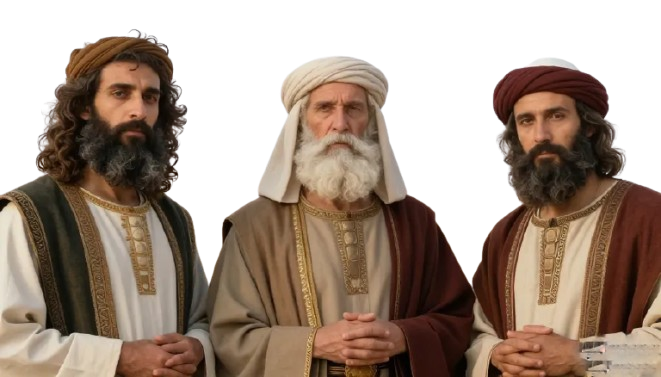

The Three Patriarchs: Mirrors of Our Own Lives
Bereshit as a mirror of human history: the war of the kings, the ideology of Nimrod, and Sodom. Watch the lecture and read its transcript →

The Three Patriarchs — Their Confrontations in Brief
Avraham facing Nimrod, Yitzchak facing Avimelech, Yaakov facing Esav: the matrix of Israel’s identity. Watch the lecture and read its transcript →
Tradition never speaks of the Patriarchs as mere ancestors. It reads them as foundations — three ways of being in the world, each lacking something, yet together standing firm.
Avraham: Going Out
The first word addressed to Avraham is a command to depart: leave your land, your birthplace, your father’s house. His whole life is outward momentum — he sets out, he welcomes passersby, he even pleads for Sodom, a city he does not know.
Avraham is generosity that flows outward. His limit lies there too: momentum that meets no resistance ends up spilling out without form.
Yitzchak: Digging Deep
Yitzchak almost never leaves the land. He reopens the wells his father had dug and the Philistines had filled in. He does not look for new springs: he clears those that already exist and have been blocked.
He is the figure of rigor, of depth, of stubborn faithfulness. His limit mirrors Avraham’s: an exacting standard without openness ends up closing in on itself.
Yaakov: Holding It Together
Yaakov is the most complex of the three, and the only one whose life is truly hard: the flight, the twenty years with Lavan, the struggle in the night, the trials of his children. He represents neither momentum alone nor rigor alone, but the synthesis — which always costs more than either of the two taken separately.
It is he who receives a second name, Israel, and it is from him that the people will take its own. As if Jewish identity could be founded neither by generosity alone nor by exacting standards alone, but only by someone who had to hold both together and bear their marks.
Continue studying
Pirkei Avot, Mishlei and the Midrash Bereshit Rabbah — the other paths of Jewish philosophy.