
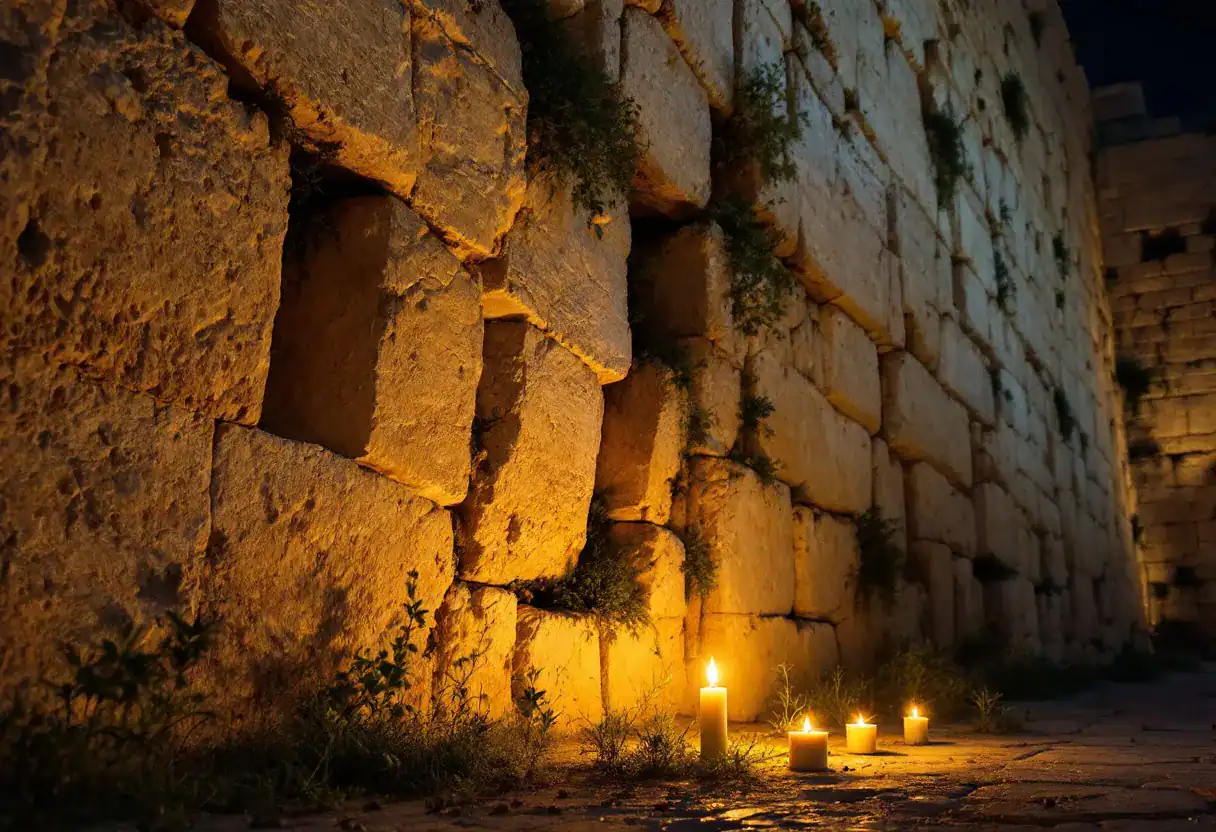
On the Ninth of Av, synagogues grow dark, people sit on the floor, and the Book of Lamentations is read by the light of a few candles. Why does this one day gather up the mourning of an entire people, how is the fast observed, and why does the tradition say that consolation is born on this very day? Answers from the sources, with insights from the lectures of Rav Raphaël Benizri.
Tisha BeAv (the ninth of the month of Av) is the national day of mourning of the Jewish people because both Temples in Jerusalem were destroyed on this date: the first by the Babylonians under Nevuchadnetzar (Nebuchadnezzar), in 586 BCE, the second by the Romans, in 70 CE. The Mishnah adds three further calamities that occurred on the same day, the first of them dating back to the wilderness. Tisha BeAv is a full fast, from sunset on the eve until nightfall the following day, preceded by three weeks of gradually intensifying mourning that begin on the 17th of Tammuz.
In 5787, Tisha BeAv begins on the evening of Wednesday, August 11, 2027, and ends at nightfall on Thursday, August 12. The fast of the 17th of Tammuz, which opens the period, falls on Thursday, July 22, 2027, and Rosh Chodesh Av on Wednesday, August 4. The fast of the 10th of Tevet, which commemorates the beginning of the siege of Jerusalem, falls this year on Sunday, December 20, 2026.
But the question “why” cannot be settled with a list of dates. As Rav Raphaël Benizri shows in his series of lectures on the fast days, the Ninth of Av is not merely the anniversary of a catastrophe: it is a date that keeps coming back, as if Jewish history kept returning to it with the same question. It is that question we will follow here.
Five calamities in a single day: what the Mishnah says
The main source is the Mishnah in tractate Taanit (4:6). It lists five events that occurred on the 17th of Tammuz and five that occurred on the Ninth of Av. For the Ninth of Av:
- The decree in the wilderness: it was decreed that the generation that had left Egypt would not enter the Land of Israel. This is the episode of the spies (the meraglim), told in Parashat Shelach (Bamidbar 13-14).
- The destruction of the First Temple, built by King Shlomo and burned by the Babylonians.
- The destruction of the Second Temple, burned by the legions of Titus.
- The fall of Betar, the last fortress of the Bar Kochba revolt against Rome, in 135.
- The plowing of Jerusalem: the city was plowed over, a Roman sign that it was never to be rebuilt.
The same Mishnah concludes with a phrase that has become proverbial: “When Av begins, we diminish our joy” (mishenichnas Av mema’atin besimchah). The Jewish calendar thus has its season of mourning, just as it has its season of joy in Tishrei.
The needless weeping in the wilderness
Why does it all begin in the wilderness? The Talmud (Taanit 29a) reads the verse “the people wept that night” (Bamidbar 14:1). The spies had returned from Canaan and described a land that “devours its inhabitants,” and the people spent the night weeping. That night, our Sages say, was the night of the Ninth of Av. And G-d declared: “You wept a needless weeping; I will establish for you a weeping for generations.”
The statement is harsh, but it provides the key: the Ninth of Av is not a date that chance happened to burden with misfortunes. It is the day on which Israel rejected its land. All the later exiles are read as echoes of that first rejection.
Why the ninth and not the tenth?
The Book of Kings says the Temple was invaded on the seventh of the fifth month (II Kings 25:8-9), while Yirmiyahu (Jeremiah) speaks of the tenth (Jeremiah 52:12). The Talmud reconciles the two (Taanit 29a): the enemies entered on the seventh, desecrated the sanctuary over the following days, set it on fire on the ninth toward evening, and it burned throughout the tenth. Rabbi Yochanan said that had he lived in that era, he would have set the fast on the tenth, since most of the Temple burned on that day. The Sages nevertheless chose the ninth, because mourning is fixed at the beginning of a catastrophe. This is why certain restrictions, such as eating meat, continue until midday of the following day.
Why was the Temple destroyed?
The Talmud asks the question frankly (Yoma 9b). The First Temple was destroyed because of three sins: idolatry, sexual immorality and bloodshed. And the Second, in an era when people studied Torah and practiced mitzvot and acts of kindness? Because of sinat chinam, baseless hatred. Hence the conclusion: baseless hatred weighs as much as the three gravest sins combined.
The Talmud confirms this diagnosis with a famous story (Gittin 55b-56a), that of Kamtza and Bar Kamtza. A man in Jerusalem holds a feast and sends his servant to invite his friend Kamtza. The servant makes a mistake and invites Bar Kamtza, the host’s enemy. The host finds him at his table and wants to throw him out. Bar Kamtza offers to pay for his meal, then for half the feast, then for the entire feast. The host has him removed by force, before the eyes of the Sages, who remain silent. Humiliated, Bar Kamtza goes to the Roman emperor, claims that the Jews are rebelling, and persuades him to send an offering to the Temple. On the way, he makes a small blemish on the animal, on its lip or its eye: a blemish that disqualifies the offering for the Jews but not for the Romans. The Sages hesitate, refuse the offering, and also refuse to do away with the informer. Rome sees this as rebellion. The war begins.
The story features no great crime. A blunder, a grudge, a silence, an excessive scruple: that, says the Talmud, is how the Temple was lost.

What Rav Benizri teaches about the origin of the destruction
In his lecture Tisha BeAv: At the Root of the Destruction, Rav Raphaël Benizri refuses to look outside for the cause of the catastrophe. He starts from one word: morashah, inheritance, which in his view appears only twice in the Torah, for the law and for the land. The two are bound together by a charter. The bond between the people and its land, he explains, is that of husband and wife, and the poison of every love is called aging and routine. When love is not renewed, the land casts out its inhabitants, and the therapy has a name: exile.
The Rav then rereads the two great sins of the wilderness. The golden calf was a rejection of the law, the spies a rejection of the land. The golden calf was forgiven, but the infidelity to the land had to be atoned for over forty years. The spies’ argument, he notes, was almost seductive: if we have a land, we will grow old like all the nations; so let us remain without borders. It was this reasoning that Kalev and Yehoshua fought against.
On Kamtza and Bar Kamtza, the Rav offers a reading of the names themselves. Kometz means a handful: Kamtza is the man closed in on his small circle, for whom anyone who does not think like him cannot come in. Yet the man who was expelled, Bar Kamtza, was precisely the one asking for openness, offering to pay for everything so that people would not exclude one another despite their disagreements. For the Rav, the real scandal is the silence of the Sages who were present: they were guests and did not want to displease. He cites the explanation of the Maharal of Prague regarding the blemish inflicted on the animal: the eye represents chochmah, the way of seeing the world, and the lip represents expression, the way of saying it. What was wounded was the shared vision and the shared speech.
His conclusion is clear: what sealed the exile was baseless hatred carried to its extreme between the factions of the people. He recalls that besieged Jerusalem had enough supplies to hold out for years, but the factions, unable to agree, burned the stores to force the people into war. And he adds a theological point: Judaism knows no “original sin,” and exile is not a punishment in the sense of vengeance. If there were no educational purpose, he says, the word punishment would have no meaning.
The destruction of the First Temple
In Tisha be-Av: The Destruction of the First Temple, the Rav goes back to the division of the kingdom after Shlomo: on one side the kingdom of Israel, which he calls the secular kingdom, on the other that of Yehudah, the religious kingdom. This tension, he stresses, is nothing new, and it weakened the people long before the armies arrived. He also speaks of King Yoshiyahu, a model king devoted both to the independence of the land and to faithfulness to the Torah, and of his successors, who had none of his virtues.
In this context he gives a definition of idolatry that stays with his listeners: it is clinging to a single idea, a single way of thinking, even within the Torah, while refusing to allow that another point of view could exist. A Torah meant to unite that instead divides opens the door to every kind of excess. He also explains why the first exile ended after seventy years, whereas the second still continues: the sins of the First Temple era stemmed from situations that could be repaired, while baseless hatred has still not come to an end.
From the 10th of Tevet to the 9th of Av: four fasts, one story
The Ninth of Av is the climax of a sequence. The prophet Zechariah (8:19) speaks of four fasts: those of the fourth, fifth, seventh and tenth months. The Talmud (Rosh Hashanah 18b) identifies them:
- the 10th of Tevet (tenth month): Nevuchadnetzar lays siege to Jerusalem (II Kings 25:1);
- the 17th of Tammuz (fourth month): the walls are breached;
- the 9th of Av (fifth month): the Temple is set on fire;
- the 3rd of Tishrei (seventh month), the Fast of Gedaliah: the assassination of the Jewish governor left in place by Babylon, which put an end to what remained of autonomy in Judea (Jeremiah 41).
The same verse in Zechariah promises that these fasts will become “for the house of Yehudah joy and gladness and festive days,” and it concludes: “love truth and peace.”
The 10th of Tevet, a fast that is never postponed
Rav Benizri devoted an entire lecture to this first fast: The Tenth of Tevet: The Fast That Opens the Destruction. He starts from a paradox. The 10th of Tevet commemorates the most low-key event of the series: a siege, with neither breach nor ruin. Yet according to an opinion cited by the halachic authorities, it is the only fast of mourning that would have to be kept even if it fell on Shabbat, whereas the Ninth of Av, which commemorates the destruction itself, is postponed to Sunday. The Rav links this rule to the verse in Ezekiel (24:2): “write down the name of the day, this very day,” as with Yom Kippur, of which the text says “on this very day.” The Sages, in fact, arranged the calendar so that the coincidence never occurs.
Why such gravity? Because, the Rav explains, citing the Maharal, the 10th of Tevet is the source, the origin of all the disintegration that followed. He notes that Zechariah nevertheless lists the fast of the tenth month last, and he looks for what is irreducible about this month. Tevet, he says, is associated with the letter ayin, which appears for the first time in the Torah in the darkness “upon the face of the deep.” Three mournings accumulate in it: the 8th of Tevet, the translation of the Torah into Greek, which the Sages compare to the day of the golden calf; the 9th, the death of Ezra the Scribe, which closes the era of the prophets; the 10th, the siege. Three successive diminishings of the light.
Finally, the Rav explains why there is no fast for the fall of the Northern Kingdom to the Assyrians. He cites Yirmiyahu’s image (50:17): Israel is a scattered sheep; the king of Assyria devoured it first, the king of Babylon crushed its bones. Ashur, our Sages say, ate the flesh of the people, while Babylon struck its marrow, its lifeblood. As long as the lifeblood remains, the people can rebuild itself; it was Babylon that put it in danger of annihilation. Hence the words describing the siege, bematzor uvematzok, “in the siege and in the straits”: being unable to spread out, remaining confined within imposed borders. He adds a remark on the people’s misplaced confidence: as long as the Temple stood, they believed themselves invincible, convinced that G-d would never touch His own sanctuary.
The Three Weeks: Bein Hametzarim
Between the 17th of Tammuz and the Ninth of Av lie three weeks, called Bein Hametzarim, “between the straits.” The expression comes from Eichah (1:3): “all her pursuers overtook her between the straits.” Mourning sets in by stages.
The customs of the Three Weeks
- From the 17th of Tammuz: according to Ashkenazi custom, weddings are not held; one avoids reciting the shehecheyanu blessing over a new fruit or a new garment; Ashkenazim no longer cut their hair or listen to music.
- From Rosh Chodesh Av: the “Nine Days.” According to Ashkenazi custom (Rema, Orach Chaim 551:9), one refrains from meat and wine, except on Shabbat and at a mitzvah meal; one reduces joyful commerce, building or decorating work, laundering clothes and bathing for pleasure.
- The week in which the Ninth of Av falls: for many Sephardic communities that follow the Shulchan Aruch (Orach Chaim 551), this is when the prohibitions on cutting hair and laundering clothes take effect; many also refrain from meat from Rosh Chodesh onward.
Customs vary considerably from community to community: consult your rabbi about your own custom.
Three Shabbatot of affliction, seven of consolation
During these three weeks, three “haftarot of affliction” are read in the synagogue, taken from Yirmiyahu and Yeshayahu. The last, read on the Shabbat before the Ninth of Av, begins with Chazon Yeshayahu, “the vision of Isaiah” (Yeshayahu 1): this is Shabbat Chazon, on which Parashat Devarim is read. In many communities, the verse “How (Eichah) can I alone bear your burdens?” (Devarim 1:12) is chanted to the melody of Lamentations. In 5787, Shabbat Chazon falls on Saturday, August 7, 2027.
After the fast come seven Shabbatot of consolation. The first, Shabbat Nachamu, takes its name from the haftarah “Comfort, comfort My people” (Yeshayahu 40:1), read with Parashat Vaetchanan. Within the calendar itself, then, mourning opens onto seven weeks of consolation that lead to Rosh Hashanah.
How Tisha BeAv is observed: the laws of the fast
The eve: the separating meal
On the afternoon of the 8th of Av, one eats a last meal before the fast, the se’udah hamafseket. According to the Shulchan Aruch (Orach Chaim 552), one does not eat two cooked dishes at it, nor meat or wine. The custom is to eat a hard-boiled egg, a symbol of mourning, sometimes dipped in a little ash (Rema, 552:6), sitting on the floor, and without three people eating together so as not to recite the zimmun. When the eve falls on Shabbat, one eats normally, and the fast begins at sunset.
The five prohibitions
Like Yom Kippur, Tisha BeAv is a “major” fast: it lasts from the evening before until nightfall the next day, and involves five prohibitions (Shulchan Aruch, Orach Chaim 554:1):
- eating and drinking;
- washing, even partially, except to remove dirt or for the morning washing of the hands, up to the knuckles;
- anointing oneself;
- wearing leather shoes;
- marital relations.
Pregnant and nursing women fast in principle. A sick person, a woman who has recently given birth or a frail person should consult a rabbi and a doctor: halachah provides for leniencies, and health always comes first.
Mourning practices
- Sitting on the floor or on a low seat, like a mourner, until midday (Orach Chaim 559).
- Not greeting one another: the usual “hello” is not exchanged; if someone greets you, you answer softly (Orach Chaim 554:20).
- Tefillin and tallit: they are not worn in the morning, because tefillin are called an “adornment” (Yechezkel 24:17). They are put on for the Minchah service in the afternoon (Orach Chaim 555:1).
- Not studying Torah, because “the precepts of Hashem are upright, gladdening the heart” (Tehillim 19:9). One studies only texts of mourning: Eichah, Iyov (Job), the somber passages of Yirmiyahu, the laws of mourning, the Talmud’s account of the destruction (Orach Chaim 554:1-2).
- From midday, the mourning eases: one may sit on a chair, and the supplication Nachem, “Comfort, Hashem our G-d, the mourners of Zion,” is added to the Minchah prayer. Sephardim already say it in the earlier prayers (Orach Chaim 557:1).
When the Ninth of Av falls on Shabbat
Mourning does not override Shabbat. When the Ninth of Av falls on a Saturday, the fast is postponed to Sunday: it is then called nidcheh, “postponed.” This is the exact opposite of the 10th of Tevet, as Rav Benizri points out.
The evening: Eichah read on the floor
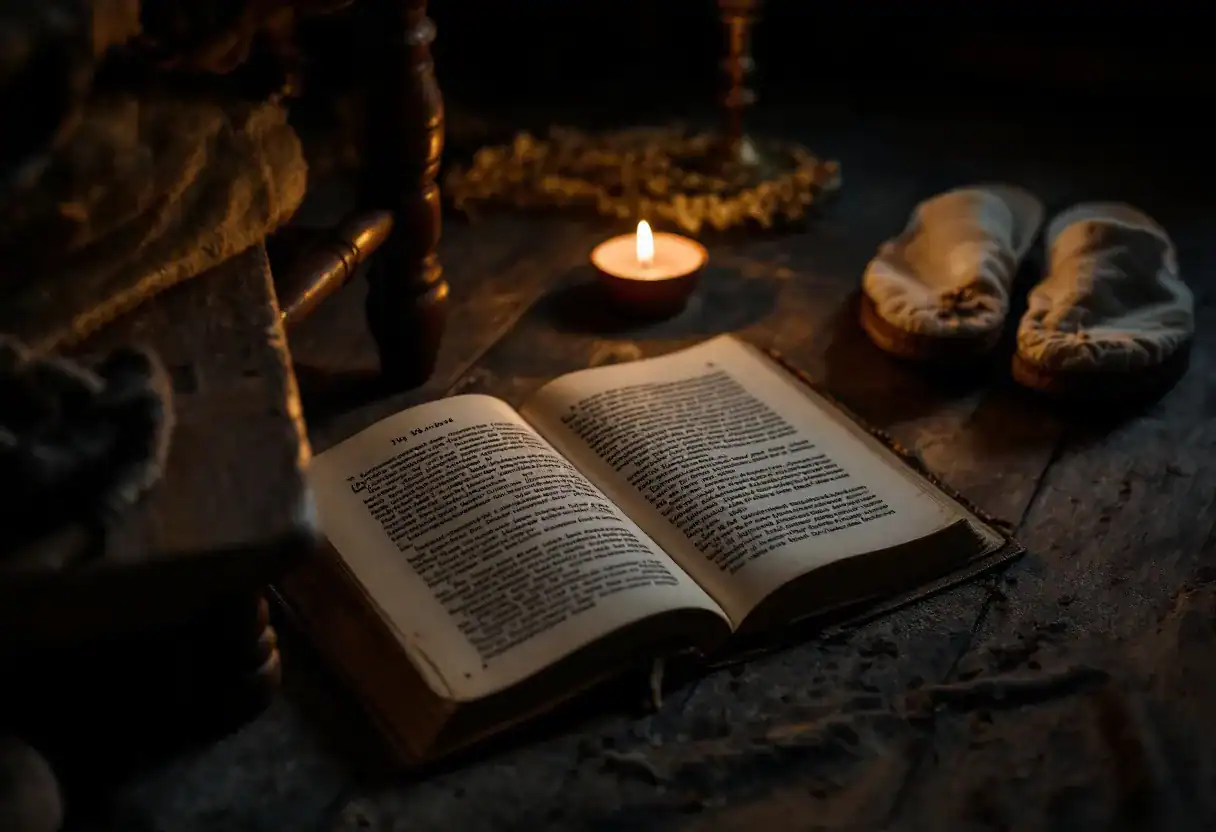
On the evening of the Ninth of Av, the curtain of the holy ark is removed, the lights are dimmed, and the congregation, seated on the floor, listens to the reading of the Book of Eichah, Lamentations, to its own special melody. Tradition attributes it to the prophet Yirmiyahu (Bava Batra 15a).
A book built on the alphabet
Eichah has five chapters. Chapters 1, 2 and 4 are acrostics of twenty-two verses, one for each letter of the Hebrew alphabet. Chapter 3 has sixty-six verses: each letter appears three times. Chapter 5 also has twenty-two verses, but not in alphabetical order. At the end, the next-to-last verse is repeated aloud, so as not to finish on a lament: “Bring us back to You, Hashem, and we shall return; renew our days as of old” (Eichah 5:21).
Rav Benizri dwells on this structure in his lecture on the First Temple. The disorder of the fifth chapter expresses both confusion and consolation: he cites a Chassidic thought according to which Mashiach will put this chapter back in order. And the last verse, which seems to speak of rejection, should be understood as a passing outburst of anger, not as abandonment.
“Eichah” and “Ayekah”: where are you?
The Midrash (Eichah Rabbah) notes that three prophets said “Eichah”: Moshe (“how can I alone bear your burdens?”, Devarim 1:12), Yeshayahu (“how has the faithful city become a harlot?”, Yeshayahu 1:21) and Yirmiyahu (“how does she sit alone?”, Eichah 1:1). The Midrash also links this word to Ayekah, “where are you?”, addressed to Adam after the sin (Bereishit 3:9): the same letters, read differently.
The Rav makes this the heart of his reading, in the lecture on the First Temple. Eichah is not primarily a lament; it is a question: where are you, where do you stand? Adam, after the tree, must go out into exile to take stock of himself. The Land of Israel is the Eden of the Jewish people, and reading Eichah on the evening of the Ninth of Av, he says, is less about weeping over the past than about reflecting on the direction of the future. He also recounts the episode of Yirmiyahu 36: the prophet has his scroll read before King Yehoyakim, who burns it, and Yirmiyahu must dictate it a second time to Baruch ben Neriyah. Tradition identifies this scroll with Lamentations.
The first chapter, verse by verse
In Tisha beAv: The Book of Eikha, the Rav reads the entire first chapter. He begins with a remark on the very meaning of the fast: if a book of lamentations were written for every tragedy in Jewish history, not a single day of joy would remain in the year. The Sages therefore concentrated everything into this period. The destruction of the Temple that we mourn includes all the tragedies that followed, up to the Shoah.
- Rabati am does not mean “full of people” but “great through her people”: the city stood out through the quality of its inhabitants, not their number.
- Ke’almanah: “like a widow,” not “a widow.” The husband has gone far away, but he is not dead and he will return. The Rav recalls that G-d never gives His people a bill of divorce.
- Weeping at night: “she weeps, she weeps in the night” (Eichah 1:2). The Jewish people, the Rav explains, must not show that it has lost hope; if it weeps, it is at night, in secret, and by day the tears have marked the face without ravaging the spirit.
- Oyev and tzar: the oyev is the enemy with whom one can trade and live as a neighbor, but who does not love us; the tzar is the oppressor who openly declares his hatred.
- Merov avodah, “through excessive servitude” (1:3): the Rav reads here a people that was too eager to please, that adopted the mindset of the nations instead of asserting its own values.
- “The roads of Zion mourn” (1:4): for lack of pilgrims. The pilgrimage festivals served for spiritual renewal and for meeting one another; a strictly observed practice that does not turn toward the other is, he says, another form of idolatry.
Finally, the Rav recalls that there were two days of great joy in Jerusalem: Yom Kippur and the 15th of Av, when the young women went out in borrowed garments to meet their future husbands (Mishnah Taanit 4:8). Rebuilding comes through the family. And he refuses to end on a sad note: the generation that lived through the drama of the war also recovered the smile that allowed it to rebuild its people and its country. The hoped-for sanctuary is not primarily a place of animal sacrifices, but the place where man sacrifices his own animal nature so as to bring forth within himself the image of G-d.
The morning: the kinot
In the morning, after the Torah reading (Devarim 4:25-40, which foretells exile and return) and the haftarah (Yirmiyahu 8:13 – 9:23), the kinot are recited, elegies composed over the centuries. The oldest are attributed to Rabbi Elazar Hakalir, a liturgical poet of the Byzantine period in the Land of Israel. Communities added lamentations over the massacres of the Crusades, over the expulsion from Spain, and more recently over the Shoah.
Among the most famous are the Zionides of Rabbi Yehudah Halevi (Spain, 12th century), which begin: “Zion, will you not ask after the welfare of your captives?” Yehudah Halevi, according to tradition, set out for the Land of Israel at the end of his life. The kinot often move from mourning to hope: several collections end with poems of consolation about Zion rebuilt. Sephardic communities have their own collections and melodies, and in many North African families the Book of Job is also read on this day.
Why is Job read on Tisha BeAv?
The Book of Iyov is one of the few texts permitted on the Ninth of Av. But for Rav Benizri, this is not only a matter of halachah: it is the book that asks, on the scale of a single person, the question that the Ninth of Av asks on the scale of a people. Why does the righteous man suffer?
The Rav devoted two lectures to Iyov. In Tisha BeAv: The Book of Iyov (Job), he recounts that as a child he would stay after the service with his grandfather to read a few chapters of it: Iyov raises the problem of human suffering and, by extension, that of the Jewish people.
A man for all times
Our Sages propose several eras in which to place Iyov (Bava Batra 15a-b): the time of the Patriarchs, among Pharaoh’s advisers, the time of the spies, under Achashverosh. In other words, the Rav concludes, Iyov belongs to every era and to none. In his introductory lecture, Tisha BeAv: Rising Above Oneself, he goes further: “it could be you, it could be me.” Iyov is not Jewish; he lives in the land of Utz, which no one can locate: he is the prototype of the human being, on whatever continent.
A piety that is not shared
The text calls him “blameless and upright, fearing G-d and shunning evil” (Iyov 1:1). The Rav reads this portrait closely. It does not say that Iyov was wise: his faith rests on tradition more than on knowledge. The text says he fears Elokim, not the Name of Hashem: a fear that waits for its reward, and that is not sustained by love of G-d. Above all, nothing is said of any act of kindness toward others. Avraham waited for passersby at the entrance of his tent; with Iyov, there is no open door. His children hold feasts, and he offers sacrifices in their place: a tradition that is no longer being passed on, and the Rav asks where the father’s responsibility lies.
He presents the positions of the three friends. For Eliphaz, misfortune atones for sins; for Tzofar, G-d tests only the righteous in order to elevate them; for Bildad, it is pointless to question how the world is run. Elihu, the youngest, offers the synthesis: Iyov sets himself up as the interlocutor of the Judge of the universe, without seeing that his very life is a blessing. In Iyov’s name, the Rav observes, lies hidden the word oyev, enemy: Iyov is his own enemy.
The answer: reaching out a hand
When G-d finally speaks, He begins by rebuking the friends, then asks: “Where were you when I laid the foundations of the earth?” (Iyov 38:4). And the decisive detail, for the Rav, comes at the end: G-d restores Iyov’s fortune after he has prayed for his friends (Iyov 42:10). G-d does not rejoice in the suffering of the righteous, he says: He is in exile with man and suffers with him. He connects this passage with a story in the Talmud (Berachot 5b): one master visits another who is suffering and asks him whether his sufferings are dear to him. “Neither they nor their reward,” answers the sick man. So the visitor reaches out his hand and raises him up.
That is why, the Rav concludes, Iyov is read on Tisha BeAv: we lost our sanctuary and forced G-d to go into exile with us; too often we have reduced our faith to our own selves, without kindness and without an outstretched hand. Iyov ends by saying: “I had heard of You by the hearing of the ear, but now my eye sees You” (Iyov 42:5). Moving from speeches about faith to the experience of a presence: that is the path.
Asked about the Shoah, the Rav answers that one must not look for an answer. What we must realize is that we did not suffer alone, and that the people continues to exist when so many empires have vanished.
Why is Torah study forbidden on this day?
This is the question that opens the lecture Tisha BeAv: Rising Above Oneself. Study is forbidden because it gladdens the heart, and the Ninth of Av is a day of mourning. But the Rav draws a deeper lesson from it: this day imposes a pause in order to take up the reading of the Torah in a new way. If the Torah no longer speaks to us, he says, it is not the Torah that is outdated: it is we who no longer measure up to its message.
He illustrates this with the grammar of blessings. We say al hamilah, “concerning circumcision,” but the father who circumcises his son says lamul, “to circumcise”; we say lehadlik ner, “to kindle the light” of Chanukah. In these formulas, the mitzvah is no longer imposed from outside: it is my own light that extends itself. And this, according to the Rav, is the heart of the destruction of the Temple: when the sanctuary becomes a place outside of us, where one goes to discharge an obligation, one gains only a minimal benefit from it. True renewal requires an inner expectation, an exchange between two lights.
Mashiach is born on the Ninth of Av: the consolation
The mourning of the Ninth of Av already contains its consolation. A story in the Jerusalem Talmud (Berachot 2:4) and in the Midrash (Eichah Rabbah 1:51) relates that on the day the Temple was destroyed, the redeemer, named Menachem, “the comforter,” was born. The Talmud also teaches: “Whoever mourns for Jerusalem will merit to see her joy” (Taanit 30b). And the Mishnah recalls that the 15th of Av, six days after the fast, was one of the most joyful days of the year (Taanit 4:8).
Rav Benizri gives a personal explanation of this tradition in his lecture on rising above oneself. On Yom Kippur, he says, we remain dependent on G-d’s forgiveness: we place ourselves in His hands. On Tisha BeAv, the people becomes aware that everything depends on it, that it is up to the people itself to overcome its weaknesses. That is why Mashiach is born on the Ninth of Av: on that day, the people understood that it is from itself that all rebuilding can come.
The same idea runs through his other lectures. The breaking of the first Tablets, he explains in the lecture on the First Temple, was not an accident but a necessity: without it, there would be neither an Oral Law nor second Tablets. The Jewish people integrates death into life; ruin becomes the condition for a new beginning. He also states frankly that blessing G-d for misfortune as for good fortune remains an ideal and not an achievement: “we are not there yet.” It is a process of becoming, the ability to see, through a crisis, a new beginning taking shape.
Each person carries his own sanctuary
In the same lecture, the Rav recalls that the word mishkan, sanctuary, is written with four letters, which he reads as the initials of the four powers: melech (the king), shofet (the judge), kohen (the priest) and navi (the prophet). When one is missing, the history of the people begins to limp. And in answer to a question from the audience, he says that this mishkan was given to every person: each of us must be our own king, our own judge, our own kohen and our own prophet, even when the institutions are lacking. The destroyed Temple, in this sense, remains to be rebuilt within each one of us.
Frequently asked questions about Tisha BeAv
Is Tisha BeAv a Torah fast?
No. It is a fast instituted by the prophets and the Sages, mentioned by Zechariah (8:19). Yet it has the severity of Yom Kippur: it lasts about twenty-five hours and involves the same five prohibitions. The three other fasts connected with the destruction (10th of Tevet, 17th of Tammuz, 3rd of Tishrei) last only from dawn until nightfall.
Why do we eat an egg before the fast?
The egg is the traditional food of mourning: it is served to mourners on their return from the burial. Its round shape evokes the cycle of life. Eating it at the last meal before the Ninth of Av, sometimes with a little ash, means entering the fast the way one enters mourning.
May one work on the Ninth of Av?
Work is not forbidden as it is on a festival, but the Sages advise against becoming absorbed in it, especially before midday, so as not to be distracted from mourning (Shulchan Aruch, Orach Chaim 554:22). Customs differ from place to place; ask your rabbi for guidance.
Why fast if the Temple was destroyed two thousand years ago?
Because, as Rav Benizri says, the destruction includes all the tragedies that followed. And because its underlying cause, baseless hatred, has not disappeared. The fast is not a frozen commemoration: it is a collective examination of conscience. The Talmud says that a generation in whose days the Temple is not rebuilt is considered as if it had been destroyed in its days (Jerusalem Talmud, Yoma 1:1).
What can one do on the Ninth of Av if one cannot study?
One may read Eichah and its commentaries, the Book of Iyov, the Talmud’s accounts of the destruction (Gittin 55b-58a), the laws of mourning, or listen to lectures on these subjects, such as Rav Benizri’s on the fast days. It is also a day well suited to reconciliation: repairing a broken relationship is the best answer to baseless hatred.
What happens after the fast?
When the fast ends, one washes one’s hands and may eat, but according to Ashkenazi custom one still refrains from meat and wine until midday the next day, since the Temple burned until the 10th of Av. Many have the custom of reciting the blessing over the moon (kiddush levanah) that same evening. The following Shabbat, Shabbat Nachamu, opens the seven weeks of consolation.
Conclusion: weeping in order to rebuild
The Ninth of Av is a day of mourning because on it the Jewish people twice lost its sanctuary, its sovereignty and its city. But the tradition does not make it a mere anniversary. From the night of the spies to Kamtza and Bar Kamtza, the sources read in it one and the same sin: rejecting the land, rejecting the other, closing the circle. And they read in it one and the same promise: the comforter is born on the day of ruin, and the fasts will become festivals.
This is the thread that runs through Rav Raphaël Benizri’s five lectures on Tisha BeAv and his lecture on the 10th of Tevet: the most formidable enemy is within, and it is therefore from within that rebuilding can come. To go deeper, listen to them in order, and continue with the pages on the weekly parasha, especially Shelach, Devarim and Vaetchanan. Hebrew terms are explained in the glossary.
Going further
- The Fast Days: all of Rav Benizri’s lectures
- The Tenth of Tevet: The Fast That Opens the Destruction
- Tisha be-Av: The Destruction of the First Temple
- Tisha BeAv: At the Root of the Destruction
- Tisha beAv: The Book of Eikha
- Tisha BeAv: Rising Above Oneself
- Tisha BeAv: The Book of Iyov (Job)
- All the Jewish holidays
- Where to start?
Article by the Pensées Juives editorial team. The passages attributed to Rav Raphaël Benizri are drawn from his lectures published on this site.