

Two thousand years of Jewish thought are held together by a chain of masters who answer one another, contradict one another and carry one another forward. Here is a chronological overview of the greatest among them, from Rabbi Akiva to Rav Kook: what each one wrote, what each one contributed, and how Rav Raphaël Benizri brings them into dialogue in his lectures.
The great Jewish thinkers are not a gallery of isolated portraits; they form a chain. Pirkei Avot (the “Ethics of the Fathers”) opens with this very image: “Moshe received the Torah from Sinai and handed it down to Yehoshua, Yehoshua to the Elders, the Elders to the Prophets, and the Prophets handed it down to the men of the Great Assembly” (Avot 1:1). Each master receives, comments on and debates what he has received, then passes it on enriched. Rabbi Akiva opens up the Oral Law as we know it, Saadia Gaon gives it a philosophical language, Rashi makes it readable for everyone, the Rambam organizes it, the Ramban deepens it, the Maharal and the Ramchal reveal its inner structure, the Baal Shem Tov makes it sing, and Rav Kook links it to Israel’s return to its land.
This article follows chronological order. For each master, it gives the dates, the main works and the central idea. It also shows how Rav Raphaël Benizri actually quotes them in his lectures: never as authorities lined up in a row, always as voices that answer one another.
A Living Chain, Not a Museum
Before travelling through the centuries, we need to understand what the Jewish tradition means by a “thinker.” It is not a philosopher who builds a system out of nothing. The Jewish master always starts from a received text, the Written Torah, and from a tradition of interpretation, the Torah she-be’al peh, the Oral Law. His genius lies in making that text speak to his generation.
Rav Benizri stresses this point in his introductory lecture on Pirkei Avot. The Tannaim, the masters of the Mishnah, “are only one link in this chain, and we are continuing it”: the tractate runs from Moshe to our own day, and it is not over. The Written Law, he explains, is fixed; its letters have been counted. The Oral Law, by contrast, is still on the move. He connects the word Torah to the root harah, to conceive, the word used for a pregnant woman: the Torah is “in permanent gestation,” a seed that must grow.
In a lecture on Bereshit Rabbah 40, he describes the history of Jewish thought as a series of superimposed layers. The cycle of the Written Law is developed by the Oral Law, the Oral Law is deepened by the Zohar, then come the rabbinic developments, Rashi, the Tosafot and all those who follow, then the Middle Ages, the Renaissance, our own era. “Each one reveals its own light according to its time.” It is in this spirit that the great names below can be read.
The Sages of the Mishnah and the Talmud (1st – 5th Centuries)
Hillel and Shammai: Two Schools Arguing for the Sake of Heaven
At the end of the Second Temple period, two masters dominate: Hillel the Elder, who came from Babylonia, and Shammai. Their schools, Beit Hillel and Beit Shammai, disagree on hundreds of points of law. The Talmud relates that a heavenly voice decided: “These and those are the words of the living G-d, but the law follows Beit Hillel” (Eruvin 13b). The reason given is the humility of Hillel’s disciples, who quoted the opinion of their opponents before their own.
It is Hillel whom a prospective convert asks to teach him the whole Torah “while standing on one foot.” The answer: “What is hateful to you, do not do to your fellow. That is the whole Torah; the rest is commentary. Go and study” (Shabbat 31a).
Rav Benizri returns to these struggles in Pirkei Avot: The Three Pillars of the World. Every great upheaval in Jewish history, he explains, comes with rival currents: Pharisees, Sadducees, Zealots, and great schools such as those of Hillel and Shammai. A rule of conduct does have to be decided. But, the Rav warns, one must “never underestimate or reject the other’s opinion, dismissing it as extremist or excessive, without having analyzed it from several angles.” That is why the Mishnah records a law and its opposite.
Rabbi Yochanan ben Zakkai: Saving the Torah as the Temple Falls
During the siege of Jerusalem, in 70 CE, Rabbi Yochanan ben Zakkai has himself carried out of the city in a coffin and obtains from the Roman general Vespasian “Yavneh and its sages” (Gittin 56b). This act is one of the most decisive in Jewish history. The Temple is destroyed, but study survives. Judaism moves from the sanctuary to the house of study, and it is at Yavneh that the Oral Law begins to be organized.
Rabbi Akiva: The Moshe of the Oral Law
Rabbi Akiva ben Yosef (c. 50 – c. 135) is undoubtedly the most towering figure of the period. According to tradition an illiterate shepherd until the age of forty, he became the master of thousands of disciples. Almost the entire Mishnah flows from his teaching, through his students Rabbi Meir, Rabbi Yehudah, Rabbi Yossi, Rabbi Shimon and Rabbi Elazar ben Shammua. He supported the Bar Kokhba revolt against Rome and died a martyr, tortured by the Romans, while reciting the Shema (Berakhot 61b).
The Talmud tells a dizzying story (Menachot 29b). Moshe ascends to heaven and finds G-d tying crowns onto the letters of the Torah. He asks why. G-d answers that a man will come, many generations later, Akiva ben Yosef, who will derive mountains of laws from every stroke of every letter. Moshe sits in on his lecture without understanding it and is dismayed, until a disciple asks for the source of a teaching and Rabbi Akiva replies: “It is a law given to Moshe at Sinai.”
Rav Benizri has devoted fine pages to this master. In Lag BaOmer: The Fires and the Light of the Zohar, he takes up this story: Moshe holds the Written Law, Akiva will open up the Oral Law, “the one that is measured by each person’s perception.” He adds a powerful idea. In his view, Rabbi Akiva reached the fiftieth level, which Moshe himself had not reached. He could do so because he was the son of converts: the ger, the convert, gains access to a level that birth does not confer. In Tisha be-Av: The Destruction of the First Temple, he sums it up: “Rabbi Akiva is the counterpart of Moshe in the Oral Law.” If he was able to love G-d “with all his soul,” even at the moment of death, it is because death was not an end for him but, as the Maharal of Prague puts it, an absence that prepares something else.
The same Lag BaOmer lecture returns to the tragedy of Rabbi Akiva’s twenty-four thousand disciples, who died between Pesach and Shavuot “because they did not treat one another with respect” (Yevamot 62b). The Rav sees in it a lesson for every scholar: it was the arrogance of the talmid chacham, the learned man who begins to speak down to the ordinary person, and not ignorance, that devastated the school. He also develops this period in The Month of the Omer: Counting in Order to Count Oneself.
Finally, Rabbi Akiva left a famous formula: “Love your neighbor as yourself: this is a great principle of the Torah.” His companion Ben Azzai counters with another verse: “This is the book of the generations of man… in the image of G-d He made him” (Bereshit Rabbah 24:7). The Rav analyzes this debate in Bereshit: The Foundations of the Human Being and in Pirkei Avot: The Mitzvah According to Ben Azzai. In The Three Patriarchs: Their Confrontations in Brief, he sheds light on “as yourself”: it is in loving your neighbor that you fulfill yourself; without that openness, a person remains “locked inside his ego.”
Rabbi Shimon bar Yochai, Rabbi Yehudah HaNasi and the Talmud
Among Rabbi Akiva’s disciples, Rabbi Shimon bar Yochai holds a place of his own. Tradition attributes to him the teaching of the Zohar, the great book of Kabbalah, and Lag BaOmer is the day of his hillula, the anniversary of his death, which is celebrated rather than mourned. For Rav Benizri, Rabbi Shimon “inherited the scholarship and opened up something else”: after a Torah of judgment, he brings mercy, and the Zohar is a Torah of renewal. The halakhah is settled; the sod, the secret, is renewed every day.
Around the year 200, Rabbi Yehudah HaNasi, known simply as “Rabbi,” redacts the Mishnah in six orders. The following generations, the Amoraim, discuss it in the Land of Israel and in Babylonia. Two Talmuds result: the Jerusalem Talmud, and the Babylonian Talmud, closed around the year 500 by Rav Ashi and Ravina. The Babylonian Talmud would become the foundation of all Jewish study. The Rav presents the structure of the six orders of the Mishnah, and the place of Pirkei Avot toward the end of the order of damages (Nezikin), in his first lecture on Pirkei Avot.
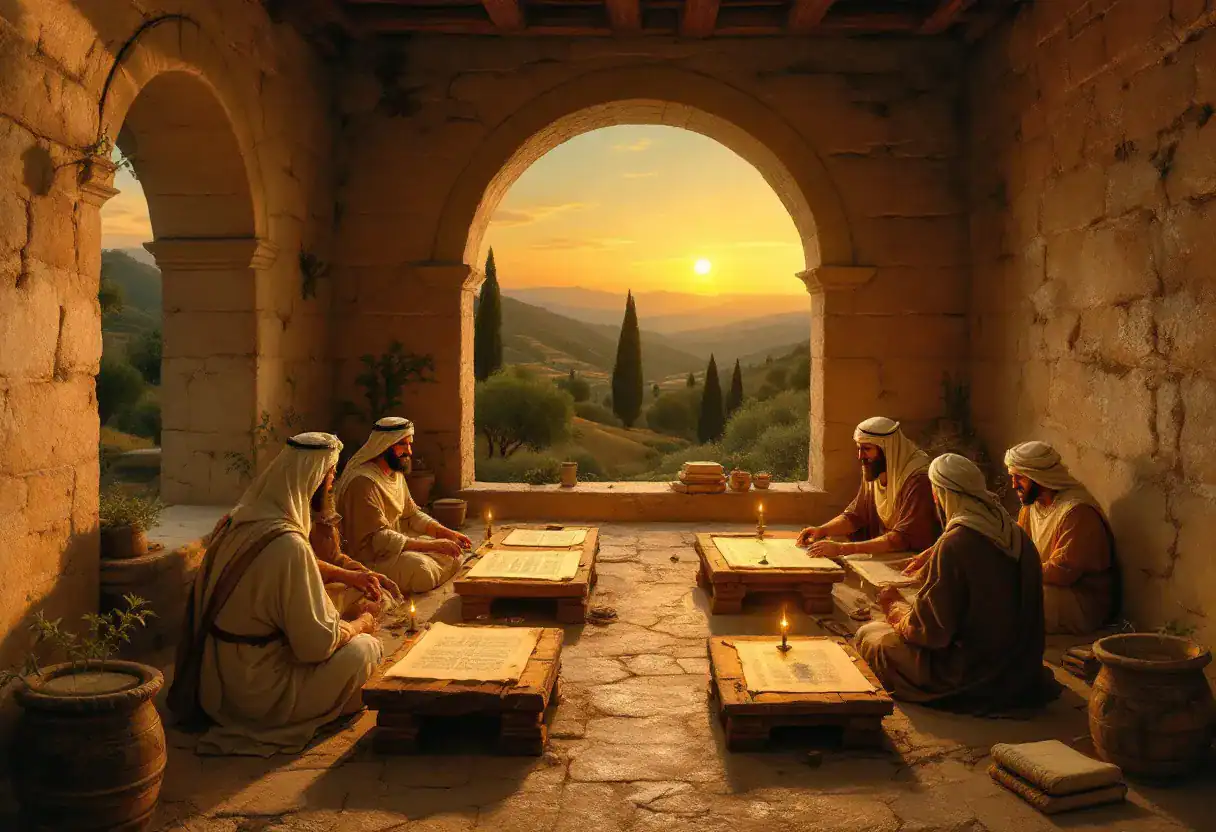
Rav Saadia Gaon (882 – 942): Jewish Thought Enters into Dialogue with Philosophy
After the Talmud comes the era of the Geonim, the heads of the great academies of Babylonia, Sura and Pumbedita. The most famous is Rav Saadia ben Yosef, born in Egypt and appointed Gaon of Sura in 928. He translated the Torah into Arabic, compiled one of the first organized prayer books, fought the Karaites who rejected the Oral Law, and wrote the first great work of Jewish philosophy: The Book of Beliefs and Opinions (Emunot ve-De’ot). His conviction: reason and revelation do not contradict each other, and revelation allows us to reach more quickly what reason would discover on its own.
We owe him a sentence that Rav Benizri quotes in his lecture Shavuot: The Book of Ruth and Hesed: “our nation is a nation only by virtue of its Torot” (Emunot ve-De’ot, Treatise III). The Rav concludes that the Torah is not a religious extra that one studies if one feels like it: it is “the very essence of our identity.” In Pirkei Avot: Acquiring the Torah Before Shavuot, he also points out a disagreement between Rav Saadia Gaon and the Rambam over the seven laws of the children of Noah. For Saadia, they were revealed to Noah and have been observed ever since. For the Rambam, a new covenant was sealed at Sinai and now binds all peoples. The Rav concludes that the “crown of Torah” cannot be worn without including the nations.
Rashi (1040 – 1105): The Teacher of Every Student
Rabbi Shlomo Yitzchaki, known as Rashi, lived in Troyes, in Champagne. He made his living from his vineyards and headed a school. He wrote a commentary on almost the entire Bible and almost the entire Babylonian Talmud. His strength is clarity: in a few words he answers the question the reader is asking, often before the reader has put it into words. After the Bible itself, no Jewish text has been studied as much: for centuries, children have learned Torah “with Rashi.” His grandsons, the Rashbam and Rabbeinu Tam, founded the school of the Tosafists, whose notes surround every page of the Talmud.
Rav Benizri quotes Rashi at every turn. In Bereshit Rabbah 39, Part 6: Goy Gadol, he starts from Rashi’s very first comment on “Bereshit” (Bereshit 1:1): if the Torah begins with creation and not with the first mitzvah, it is to establish that the Master of creation gives the land to whomever He wishes. The Rav concludes that, in the order of the narrative, the Land of Israel precedes the people and its Torah. In Vayeshev: The Heritage of the Fathers, he takes up Rashi’s remark on Yaakov, who wanted “to settle in peace” (Bereshit 37:2): a righteous person can never retire. In Vayera: The Promises to Avraham (Part 2), he draws on “Rashi’s grandson,” the Rashbam, the only one to see in Avraham’s covenant with Avimelech a danger for his descendants.
A personal detail, slipped in at the end of a lecture on Noach: The Three Creations of Man, speaks volumes. The Rav explains that he will pick up the following year where he left off, because that is how he studied Rashi, every Shabbat, with his teacher Emmanuel Levinas. Here, the chain runs through the Rav himself.
Rabbi Yehudah HaLevi (c. 1075 – 1141): The Poet of Zion
A physician and poet of the golden age of Spanish Jewry, Rabbi Yehudah HaLevi wrote the most beautiful Hebrew poems of the Middle Ages, among them the “Songs of Zion”: “Zion, will you not ask after the welfare of your captives?” His book of thought, the Kuzari, portrays a Khazar king who questions a philosopher, a Christian, a Muslim and then a Jewish sage. Against the philosophers, Yehudah HaLevi maintains that the faith of Israel rests on a historical experience, the revelation lived by an entire people at Sinai, and not on a demonstration. At the end of his life he left Spain for the Land of Israel; he died shortly afterwards, around 1141.
One image from the Kuzari has become famous: Israel among the nations is “like the heart among the organs” (Kuzari II:36). Rav Benizri takes it up in Bereshit Rabbah 39, Part 5: we are “the beating heart of humanity,” and that is why G-d sends Yonah to preach in Nineveh. We are responsible for all of humanity, but from our own anchor point. In Purim: The Festival Born in Exile, he quotes his warning against being seduced by the beauty that other cultures display without looking at what it conceals. And in Elul: The Reckoning of the Year, he recalls the call that Rabbi Yehudah HaLevi placed in the selichot, the prayers for forgiveness: “sleeper, do not sink into your slumber.”
The Rambam, Maimonides (1138 – 1204): The Architect
Rabbi Moshe ben Maimon was born in Córdoba in 1138 (some say 1135). Driven out by the Almohad persecutions, he passed through Fez and the Land of Israel, then settled in Fustat, near Cairo, where he became a court physician. His body of work is colossal:
- The Commentary on the Mishnah, written in Arabic, with its great introductions: the Shemonah Perakim (“Eight Chapters”), an ethical treatise that introduces Pirkei Avot, and the thirteen principles of faith.
- The Mishneh Torah, or Yad HaChazakah, in fourteen books: the first complete code of all of Jewish law, including the laws of the Temple and of kingship.
- The Guide for the Perplexed (Moreh Nevuchim), written for the person whose faith is unsettled by philosophy: it deals with the divine names, prophecy, providence and the reasons for the commandments.
The Mishneh Torah opens with these words: “The foundation of foundations and the pillar of all wisdom is to know that there is a First Being” (Hilchot Yesodei HaTorah 1:1). In Purim: The War against Amalek, Rav Benizri sets this sentence beside the introduction of the Ramchal, written centuries later, and reads them together as the answer to the question of the meaning of life: to discover the divine hidden within us.
The Rambam is the thinker the Rav quotes most often, and almost always to open up his thought rather than to close it. In Pirkei Avot, Part One, he recalls that the Rambam, in the introduction to the Shemonah Perakim, says he drew on our Sages but also on the philosophers, even those of other peoples. He does not give his sources, “for pedagogical reasons,” so that no one judges an idea by its origin. The Rambam says so himself in that introduction: one must “hear the truth from whoever speaks it.” The Rav sees in this what the Jewish people has done throughout its history: integrate the insight of other peoples into what it has received. He also shows that the Rambam is of two minds: in the introduction to the Mishnah, he reserves the tractate of Avot, on the contrary, for someone who has already absorbed the Torah.
Elsewhere, the Rav brings other parts of this body of work into play:
- In Tisha BeAv: The Book of Iyov (Job) and Tisha BeAv: Rising Above Oneself, he sets out the three sources of misfortune according to the Rambam (Guide III:12): what stems from nature, what people inflict on one another, and what a person inflicts on himself through the misuse of his free will.
- In Pesach: Where Should the Haggadah Begin?, he presents Adam’s sin according to the Rambam: it begins with the gaze cast on the fruit, seduced by appearance. That is why, the Rav says, the Rambam speaks not of an urge but of a way of conceiving the world.
- In Pirkei Avot: All Israel Has a Share in the World to Come, he shows that for the Rambam morality lies both before the law and beyond it.
The Ramban, Nachmanides (1194 – c. 1270): The Depth of the Text
Rabbi Moshe ben Nachman, of Girona in Catalonia, was at once a Talmudist, a physician and a Kabbalist. His commentary on the Torah often debates Rashi and the Rambam, and opens up allusions to “the way of truth,” the Kabbalah. In 1263 he was forced to hold a public disputation in Barcelona against a convert, before King James I of Aragon. He spoke with such freedom that he then had to flee Spain. He went up to the Land of Israel in 1267 and rebuilt the devastated community of Jerusalem; a synagogue in the Old City still bears his name. For him, settling the Land of Israel is a commandment of the Torah.
Rav Benizri likes to set the Rambam and the Ramban in dialogue, because their disagreements illuminate the text:
- Prophecy. For the Rambam, the angels’ visit to Avraham takes place in a prophetic vision (Guide II:42). The Ramban strongly objects in his commentary (Bereshit 18:1): things happened just as the Torah tells them. The Rav lays out this debate in Bereshit Rabbah 39, Part 4, then proposes a third way: the Divine Presence speaks “from within the throat of man.” In Vayera: The Promises to Avraham (Part 1), he returns to the position of the Rambam, for whom one cannot imagine a man eating with angels, and this time sets Rabbeinu Bachya against him.
- The Hebrew language. For the Rambam, Hebrew is called the “holy tongue” because it has no crude words (Guide III:8). For the Ramban, it is the very language in which G-d revealed Himself (commentary on Shemot 30:13). The Rav draws from this two readings of the history of the language in Noach: The Tower of Babel.
- Morality beyond the law. On the verse “you shall do what is right and good” (Devarim 6:18), the Ramban explains that the Torah could not prescribe everything and leaves man a share of discovery. The Rav uses this in Pirkei Avot: The Chain of Transmission to show that morality is the “beyond” of the Torah.
- Exile. In Vayishlach: How to Avoid the Confrontation with Esav, he follows Yaakov’s three means of facing his brother, the gift, prayer and war (listed by Rashi on Bereshit 32:9), stressing what the Ramban adds to the third: the real question is not how to wage war, but how to avoid it.

From Safed to Prague: The Arizal and the Maharal (16th Century)
The Arizal and the Kabbalah of Safed
After the expulsion from Spain in 1492, great masters gathered in Safed, in the Galilee. Rabbi Yosef Karo wrote the Shulchan Aruch there, the code of law that is still authoritative. Rabbi Yitzchak Luria (1534 – 1572), the Arizal, taught there for barely two years a new reading of the Zohar, transmitted by his disciple Rabbi Chaim Vital: the contraction of the divine light, the “breaking of the vessels,” and tikkun, the repair of the world entrusted to man.
Rav Benizri quotes the Arizal on several occasions. In Pesach: Where Should the Haggadah Begin?, he recalls that, following him, Egypt is defined as the source of all impurities, and therefore the model of all exiles. In Vayechi: The Instrument of the Family, he relates that the Arizal said that during his Shabbat nap he received revelations that did not come to him the rest of the week. And in Pirkei Avot: All Israel Has a Share in the World to Come, he relates the Arizal’s teaching that everyone ultimately has a share in the World to Come, some directly, others after many detours.
The Maharal of Prague (c. 1520 – 1609)
Rabbi Yehudah Loew ben Bezalel, the Maharal, was chief rabbi of Prague. The legend of the Golem made him famous, but his work is worth far more: Gur Aryeh (on Rashi’s commentary), Gevurot Hashem (on the Exodus from Egypt), Tiferet Yisrael (on the Torah), Netzach Yisrael (on exile and redemption), Derech Chaim (on Pirkei Avot), Be’er HaGolah (on the difficult narratives of the Talmud). The Maharal seeks the inner structure of things: why this number, this order, this festival. Without speaking the language of Kabbalah, he conveys its depth in an accessible language of thought.
He is one of the masters most present in Rav Benizri’s lectures:
- The chosenness of Israel. In Pesach: Peh-Sach, the Mouth That Speaks, the Rav relates that according to the Maharal the choice of Israel is unearned: Avraham is also the father of Yishmael, Yitzchak the father of Esav. Israel’s merit is to have accepted this charge.
- Shavuot. In Pirkei Avot: Acquiring the Torah Before Shavuot, he explains with the Maharal why the Torah does not call Shavuot “the day of the giving of the Torah”: the acceptance at Sinai involved an element of coercion (the mountain held over them “like a barrel,” Shabbat 88a). The festival is therefore called the day of the first fruits, the day when man gives the best of himself.
- Study as combat. In Pirkei Avot: Let Your House Be Open, on the maxim “cover yourself in the dust of their feet” (Avot 1:4), he relates the Maharal’s reading: the word evokes struggle, ma’avak. “We are not obliged to say amen to every teaching.” The Torah shapes the personality through the friction of ideas.
- The sukkah of David. In Sukkot: From Kippur to the Sukkah of Peace, he quotes the Maharal’s question: why do we say “the sukkah of David” and not “the house of David”? A ruined house is rebuilt differently; a fallen hut is put back up exactly as it was.
- The destruction. In Tisha BeAv: At the Root of the Destruction, he explains with the Maharal the blemish inflicted on the animal sent by Bar Kamtza, on the lip and on the eye: the eye is wisdom, the lip is speech. In The Tenth of Tevet: The Fast That Opens the Destruction, he relates that the Maharal sees this day as the origin of the entire exile.
The 18th Century: Three Paths to Inwardness
The Or HaChaim and the Ramchal
Rabbi Chaim ben Attar (1696 – 1743), who was born in Salé, Morocco, and died in Jerusalem, is the author of the Or HaChaim, a Torah commentary revered in Morocco and in the Hasidic world alike. The Rav quotes him in Chayei Sarah: The Family of Avraham: the world seems to be declining on the outside, but holiness does not break; holy deeds accumulate from generation to generation.
Rabbi Moshe Chaim Luzzatto, the Ramchal (1707 – c. 1746), was born in Padua, Italy. A poet and Kabbalist, viewed with suspicion by the rabbis of his time, he ended his life in the Land of Israel. His book Mesillat Yesharim, “The Path of the Upright,” has become the great handbook of Jewish moral life. It follows the rungs of a baraita of Rabbi Pinchas ben Yair (Avodah Zarah 20b): watchfulness, zeal, cleanliness, separation, purity, piety, humility, fear of sin, up to holiness. We also owe him Derech Hashem, a systematic exposition of faith.
Rav Benizri draws on him in three ways. In Pesach: Peh-Sach, the Mouth That Speaks, he notes that the Ramchal makes holiness the end point of a journey through ten levels of virtue. Intellects differ, the Rav says, but virtues know neither weight nor measure: there, all people are equal. In Purim: The War against Amalek, he quotes the book’s introduction: the foundation of everything is that a person should know clearly what his duty is in his world. In Pirkei Avot: The Chain of Transmission, he takes up his criterion of love: a true son does not wait for his father to express a wish; he anticipates it.
The Baal Shem Tov (c. 1698 – 1760) and Hasidism
Rabbi Yisrael ben Eliezer, the Baal Shem Tov (“Master of the Good Name”), was born in Podolia, in present-day Ukraine. He wrote no book; his teachings were transmitted by his disciples, among them the Maggid of Mezeritch. He founded Hasidism, which restored to simple people the joy of divine service: G-d is present everywhere, sincere prayer and joy count as much as scholarship, and the tzaddik guides his community. His great-grandson, Rabbi Nachman of Breslov (1772 – 1810), left the Likutei Moharan and tales of great depth.
The Rav quotes the Baal Shem Tov in passages that say a great deal about his own thought. In Pirkei Avot, Part One, he relates his prayer: save Your people, but if You judge that they do not deserve it, save the other nations, for through their redemption we will come to know our own. So one does not answer hatred with hatred. In Pirkei Avot, Part 5: Serving Without Expecting a Reward, he tells the story of the etrog. On the eve of Sukkot, the Baal Shem Tov cannot find one; a man agrees to give him his own in exchange for his share in the World to Come. He accepts, and that day he dances more joyfully than ever: at last he has proof that he does not serve G-d out of self-interest. In Lech Lecha: Lot, Our Neighbor, he also quotes his reading of the verse “G-d has made the one opposite the other” (Kohelet 7:14).
In Noah: The Loosening of Morals, the Rav tells Rabbi Nachman’s tale of the menorah. A son returns from exile saying he has learned to make a menorah. No one likes his work, and he declares himself delighted: he wanted to show that each person has his own light. In Tisha BeAv: The Book of Iyov (Job), he also relates his reading of “a righteous man who suffers”: a righteous man who does not renew himself and still lives in the past.
The Vilna Gaon (1720 – 1797)
Rabbi Eliyahu of Vilna, the Gaon, held no official post. He studied day and night and mastered the whole Torah, written and oral, including Kabbalah, grammar and the sciences of his day. His notes correct the texts of the Talmud; his commentaries cover the Shulchan Aruch, the Bible and the Zohar. He firmly opposed the nascent Hasidic movement. His disciples, among them Rabbi Chaim of Volozhin, founder of the great Volozhin yeshiva, carried on his legacy, and some went up to settle in the Land of Israel.
Rav Benizri quotes him in two lectures. In Tisha be-Av: The Destruction of the First Temple, regarding the letters of the alphabet that have “no companion,” he relates a reading of the Gaon that connects them to the verse from the Song of Songs: “You are all fair, my companion, and there is no blemish in you.” In Hanukkah: A Jewish Re-education, he quotes his remark on the wording of the blessing, lehadlik ner Chanukah, and reads in it the image of the living water of a river, as opposed to the thinking that sets boundaries and lets the water stagnate.
The 19th and 20th Centuries: Responding to Modernity
Rav Samson Raphael Hirsch (1808 – 1888)
Born in Hamburg, rabbi of the Orthodox community of Frankfurt, Rav Hirsch responded to the emancipation of German Jews and to the Reform movement. His motto: Torah im derech eretz, Torah combined with general culture and with life in society. His works: the Nineteen Letters on Judaism, Horeb (an exposition of the commandments and their meaning) and a major commentary on the Torah, attentive to the roots of Hebrew words. In Noah: The Loosening of Morals, Rav Benizri takes up his definition of chen, the grace Noach found: an exceptional virtue, granted to a person, that goes beyond his own qualities. The word chen, incidentally, gave rise to chinam, free of charge.
Rav Kook (1865 – 1935)
Rabbi Avraham Yitzchak HaKohen Kook was born in Latvia. He went up to the Land of Israel in 1904 as rabbi of Jaffa, became rabbi of Jerusalem and then, in 1921, the first Ashkenazi Chief Rabbi of the Land of Israel. He saw in the return to Zion, even when led by pioneers far from religious practice, a stage of the redemption, and in every Jew a spark of holiness. He founded the Merkaz HaRav yeshiva. His works: Orot (“Lights”), Orot HaTeshuvah (on teshuvah, return), Orot HaKodesh, and the commentary on the prayer book Olat Re’iyah.
Rav Benizri quotes Rav Kook on several occasions, always on questions of identity:
- In Bereshit Rabbah 39, Part 6: according to Rav Kook, “originally all souls are Israel.” Adam, created in the image of G-d, was the portrait of all humanity. As it descends into reality, the image loses some of its substance. The Rav concludes that Israel is “in permanent becoming,” never a given.
- In Pekudei: The Inner Tabernacle: Rav Kook said that Vayikra is the “Torah of the home,” the way to live at home, and Bamidbar the law of the road, the code of conduct in exile. The law, the Rav points out, remains the same in both cases.
- In Pirkei Avot: The Chain of Transmission and in Tisha beAv: The Book of Eikha, he relates the idea that the Torah, the Land of Israel and the people of Israel form a single unity. The word morashah, heritage, is used both for the Torah and for the land. But, he adds, Rav Kook says this “only through the Torah itself.”
- In Pirkei Avot: Make Yourself a Teacher, Acquire Yourself a Friend, he quotes his idea that trials are sometimes bitter but healing remedies. That does not mean one should go looking for them.
Contemporary Thinkers
The 20th century saw the rise of thinkers who rethought the tradition in the face of the Shoah, the rebirth of Israel and modern philosophy. In France, Emmanuel Levinas (1906 – 1995), the philosopher of the face of the other and author of Talmudic readings, directed the École normale israélite orientale in Paris; Rav Benizri mentions studying Rashi with him every Shabbat. One may also mention, among many others, André Neher, Léon Ashkenazi (Manitou), Rav Joseph Soloveitchik in the United States and Rav Yehudah Ashlag in the Land of Israel. Each, in his own way, carries on the chain that began at Yavneh.
What Rav Raphaël Benizri Teaches: Reading the Masters Together
Across all these lectures, a way of reading emerges. The Rav never quotes a master to close a question. He quotes two, sometimes three, and lets the debate do its work. Rambam and Ramban on prophecy or on language, Saadia Gaon and the Rambam on the Noahide laws: disagreement is not a problem to be solved; it is the place where the Torah breathes.
He gives the reason himself in Lag BaOmer: the sod, the secret of the Torah, is the gathering together. Whoever cuts off and separates a teaching “is left with nothing but his own Torah”; the Torah of G-d is the one that gathers all the currents together. In Pirkei Avot: Let Your House Be Open, he takes up with the Maharal the idea that study is a struggle, and warns against “saturation”: having a question and an answer, and being content with that answer as though one had everything. We do not set limits on the Torah or on the ways of interpreting it: there is, he says, “always one more level of interpretation.”
Finally, there is in his teaching a conviction that runs through the centuries: each master made the Torah speak for his own time, and it is up to us to do so for ours. Each of us, he often repeats, is a letter, or part of a letter, of the Torah. Reading the great thinkers is therefore not an exercise in erudition: it is learning from them how to find one’s own share.
Frequently Asked Questions
Who is the greatest Jewish thinker?
Tradition says of the Rambam: “From Moshe to Moshe, there arose none like Moshe.” But the question does not really make sense in Jewish thought. Rabbi Akiva is the source of the Oral Law, Rashi the teacher of every student, the Rambam the architect of law and faith. Each master is a link, and none can be understood without the others.
What is the difference between the Rambam and the Ramban?
They are two Spanish masters, half a century apart. The Rambam (Maimonides) is a rationalist who engages with the philosophy of Aristotle and codifies the whole of the law. The Ramban (Nachmanides) is a Talmudist and Kabbalist; he emphasizes the mystery of the text and the literal reality of the narratives. Their debates, on prophecy, the holy tongue or the reasons for the commandments, still nourish study today, and Rav Benizri often sets them in dialogue.
Which book should I start with to discover Jewish thought?
Pirkei Avot, short and accessible, is the classic gateway: Rav Benizri devotes a complete series of lectures to it. One can then read the weekly parasha with Rashi’s commentary, and then the Ramchal’s Mesillat Yesharim or the Kuzari. To find your way around the lectures on the site, see the page Where to Start?.
What distinguishes Hasidism from the “Mitnagdim”?
The Hasidism of the Baal Shem Tov emphasizes joy, prayer and the presence of G-d in all things. Its opponents, the Mitnagdim, whose leading figure was the Vilna Gaon, feared that study and the rigor of the law would be neglected. Over time, the two movements have drawn much closer, and each today recognizes the greatness of the other.
Why does Rav Kook hold a special place?
Because he was the first great thinker to read Israel’s return to its land, at the beginning of the 20th century, as a spiritual event. He affirms the unity of the Torah, the land and the people, and sees in every Jew, even one far from observance, a spark of holiness. What Rav Benizri takes from him above all is the idea of an Israel “in permanent becoming.”
Should these masters be studied alone or with a teacher?
As Pirkei Avot says: “Make yourself a teacher and acquire yourself a companion” (Avot 1:6). These texts are dense, often written in a technical language, and are best studied with a teacher and in chavruta, in pairs. The Rav develops this maxim in Pirkei Avot: Make Yourself a Teacher, Acquire Yourself a Friend.
Going Further
The best way to meet these masters is to hear them explained. Rav Raphaël Benizri’s lectures call upon them for every parasha, every festival and every maxim of the Fathers.
- Jewish Philosophy: Rav Benizri’s Lectures
- Pirkei Avot – Ethics of the Fathers
- Bereshit Rabbah: The Midrash Explained
- The Weekly Parasha
- Lag BaOmer: Rabbi Akiva and Rabbi Shimon bar Yochai
- Glossary of Hebrew Words
- The Rav’s Books
- Where to Start?
An article by the Pensées Juives editorial team. The passages attributed to Rav Raphaël Benizri are drawn from his lectures published on this site.