

Hanukkah in History
Rav Benizri revisits the four exiles inscribed from the very creation, the internal war against the Mityavnim, the role of the kohanim and the meaning of the 25th of Kislev. Watch the lecture and read its transcript →

Hanukkah: Each Person’s Own Light
Ner ish u-veito: each person’s own light, the Oral Torah, the four stages of exchange in a lifetime, and gratitude as the key to everything. Watch the lecture and read its transcript →

Hanukkah: Maoz Tzur, the Song of the Exiles
A stanza-by-stanza commentary on Maoz Tzur: the four empires, the golden calf, the thirteen ramparts and the miracle of the eight days, followed by questions. Watch the lecture and read its transcript →

Hanukkah: A Jewish Re-education
Hanukkah as a re-education of Jewish identity: the three regalim, the notion of bayit, the thirteen breaches opened by Greece and the flame that remained intact. Watch the lecture and read its transcript →
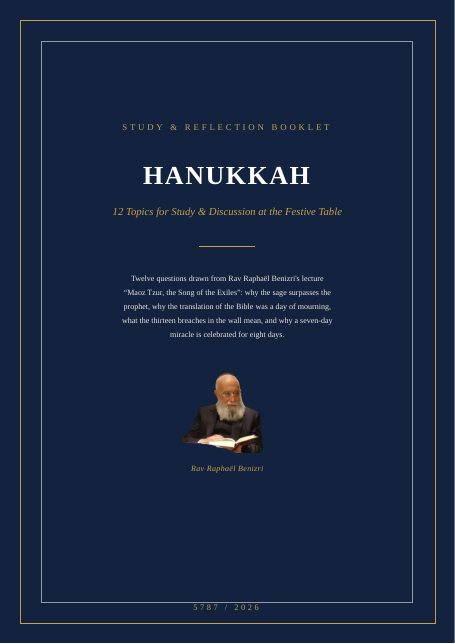
Study booklets for each lecture: questions to reflect on as a family
Hanukkah is a festival of resistance that chose to express itself through the frailest object imaginable: a small flame, set by a window, in the longest night of the year.
Above All, a Cultural War
The confrontation with the Greek empire was not only military. Hellenistic Greece did not seek to destroy the Jewish people: it sought to persuade them. It brought beauty, philosophy, the gymnasium, a brilliant civilization — and in return it asked that the Torah become one wisdom among others.
This is a subtler threat than violence, because it is seductive. One can resist an enemy; it is harder to resist something one admires.
The Cruse of Oil
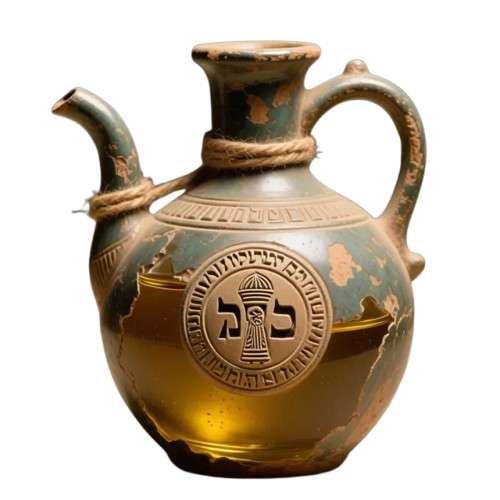
The best-known account can be told in a few words: after the Temple was retaken, only one cruse of pure oil was found, enough to last a single day, and it burned for eight days.
What is striking is not the quantity but the purity. A single cruse remained intact, sealed, untouched by the desecration. The miracle does not begin with a multiplication: it begins with the fact that something intact, however little, had survived.
A Light Turned Outward
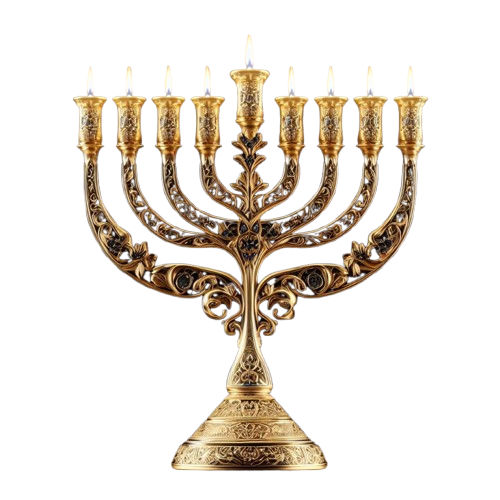
The hanukkiah is placed in the window or by the door, so as to light up the street rather than the house. It is not used for reading or for working: its light serves no practical purpose. It is there only to be seen.
And a candle is added each night rather than taken away. Against the spreading darkness, the answer is not to shield oneself more — it is to shed a little more light.
Continue studying
Purim, the other winter festival of deliverance, and the fast days, which keep alive the memory of the Temple.