
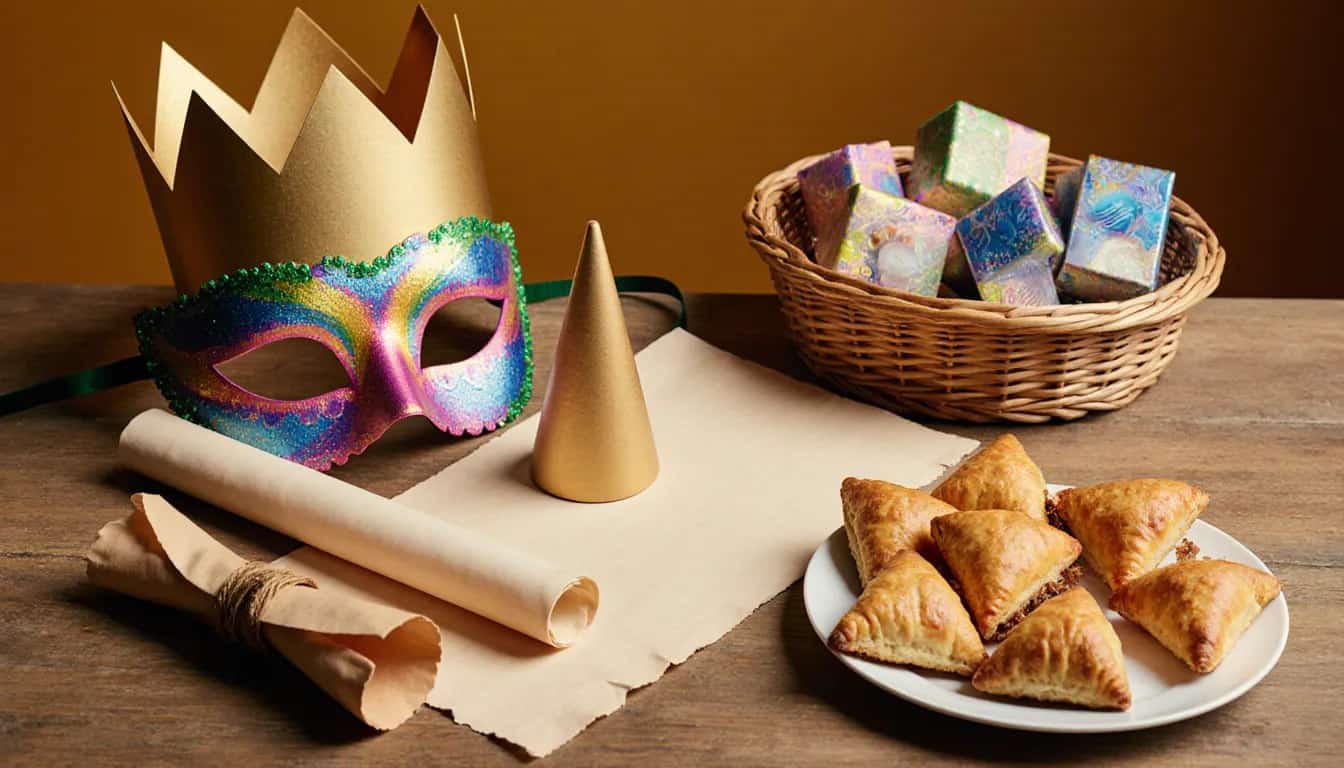
Every year on Purim, children and adults dress up as kings, queens or unexpected characters. This is no ordinary carnival: behind the mask lies the whole lesson of the Book of Esther.
In 5787 (2027), Purim falls on Tuesday, March 23. The year 5787 is a leap year: it has two months of Adar, and Purim is celebrated on 14 Adar II. The Megillah is read on Monday evening, March 22, and again on Tuesday morning. The Fast of Esther takes place during the day on Monday, March 22. In Jerusalem, Shushan Purim is celebrated on Wednesday, March 24. Shabbat Zachor, when the passage about Amalek is read, falls on Saturday, March 20.
A custom, not a mitzvah
Dressing up is not one of the mitzvot of Purim. The Talmud does not mention it. It is a custom that emerged in the Middle Ages, already mentioned by the Rema in his glosses on the Shulchan Aruch (Orach Chaim 696:8). It spread to every community, to the point of becoming the best-known image of the festival.
Why has it taken on such importance? Because it acts out what the Book of Esther recounts.
A G-d hidden behind the events
The Book of Esther has a peculiarity: the name of G-d does not appear in it even once. No prophet, no visible miracle. Everything seems to happen by chance: a queen dismissed, a young woman chosen, a plot overheard by Mordechai, a sleepless night for the king.
The Talmud (Chullin 139b) asks where Esther is alluded to in the Torah. It answers with a verse: “And I will surely hide My face on that day” (Devarim 31:18). In Hebrew, “I will hide” is astir, from the same root as the name Esther. The salvation is real, but it advances in disguise. To dress up is to recall that the hand of G-d acts behind a face that does not reveal it.
Everything is turned upside down
The book says it itself: “it was turned upside down” (venahafoch hu, Esther 9:1). On the very day the enemies of Israel hoped to dominate them, it is the Jews who prevail. Haman prepares a gallows for Mordechai and ends up on it himself.
The story is full of changes of clothing. Mordechai tears his garments and puts on sackcloth (Esther 4:1). Esther “clothes herself in royalty” to appear before the king (Esther 5:1). Mordechai is then paraded on horseback, dressed in royal garments (Esther 6:11). Finally he leaves the king’s presence in royal attire, with a golden crown and a mantle of fine linen and purple (Esther 8:15). The Purim costume echoes these reversals.
Esther herself long conceals who she is: “Esther had not made known her people or her birth” (Esther 2:10). Her identity remains veiled until the decisive moment.
The four mitzvot of Purim
The verse itself sets out the program of the festival: “days of feasting and joy, of sending portions to one another and gifts to the poor” (Esther 9:22).
- Reading the Megillah: in the evening and in the morning, listening to every word. We make noise at the name of Haman.
- Mishloach manot: sending at least two ready-to-eat foods to at least one person.
- Matanot la’evyonim: giving to at least two poor people enough for a festive meal.
- The feast (seudah): a joyful meal on the afternoon of Purim.
The Talmud (Megillah 7b) adds that one drinks on Purim “until one can no longer distinguish between ‘cursed be Haman’ and ‘blessed be Mordechai’.” The halachic authorities place strong limits on this statement, and many recommend moderation. For practical details (quantities, times, people who are housebound), consult a competent rabbi.
A few rules for costumes
Dressing up remains a joyful custom, not a license to do anything. One avoids whatever hurts, humiliates or runs counter to modesty. Certain questions, such as wearing the clothing of the opposite sex, are debated among the halachic authorities: here too, ask a rabbi’s opinion.
What Rav Raphaël Benizri says
In his lecture Purim: The War against Amalek, Rav Benizri addresses costumes directly. For him, the costumes of Purim are the costumes we wear all year long. They are garments: they are not abject in themselves. They become so when we label them in order to reject the other. The festival unmasks our taste for labels, the reflex that makes us judge by the garment rather than by the being.
In the same lecture, he reads “Esther” as the eclipse of the Divine face: G-d is sometimes eclipsed, not out of abandonment, but because we turn our backs on Him. On “ad delo yada,” he explains that the goal is not drunkenness but transcendence. He also links mishloach manot and matanot la’evyonim to an effort to include the other, the one in whom I do not recognize myself.
In Purim: The Festival Born in Exile, he recalls that the name Esther comes from “sater,” to hide. Purim is the festival of the absence of revelation: no open miracle, a hidden hand orchestrating the events.
And in Purim: The Megillah in the Present, he stresses that the name of G-d does not appear in the Megillah, not because He is absent: He is constantly present. Every use of the word “the king,” apart from the one who reigns from India to Kush, refers to Divine providence, present but invisible.
Further reading
- Purim: all of Rav Benizri’s lectures
- Purim: The War against Amalek
- Purim: The Festival Born in Exile
- Purim: The Megillah in the Present
- “Questions for the Purim Table” booklet (PDF)
- All the Jewish holidays
Article by the Pensées Juives editorial team. The passages attributed to Rav Raphaël Benizri are drawn from his lectures published on this site.