

Purim: The War against Amalek
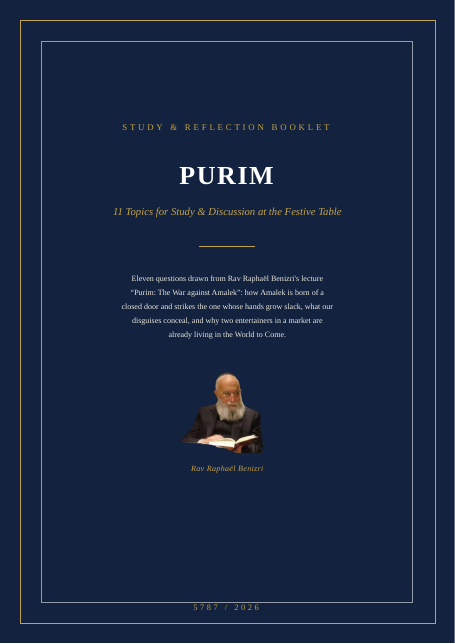
Shabbat Zachor, Refidim and the slackened hands, Mordechai the “mor dror,” Esther’s eclipse, and joy as the essence of Purim. Watch the lecture and read the transcript →

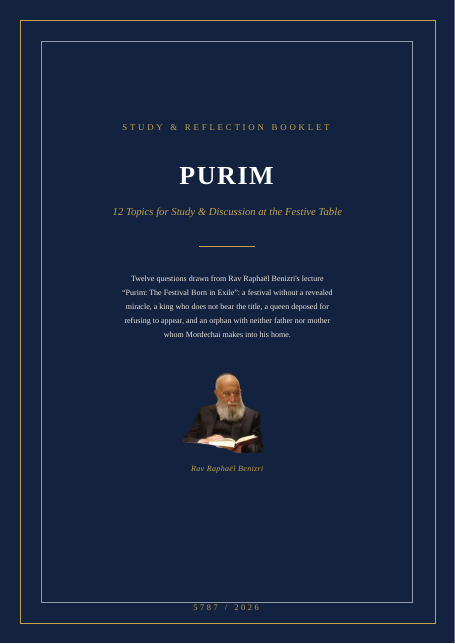
Purim: The Festival Born in Exile
The only festival born outside the Land of Israel: exile and the loss of identity, Achashverosh and Vashti, Haman the Agagite, and Esther’s grace. Watch the lecture and read the transcript →

Purim: The Megillah in the Present
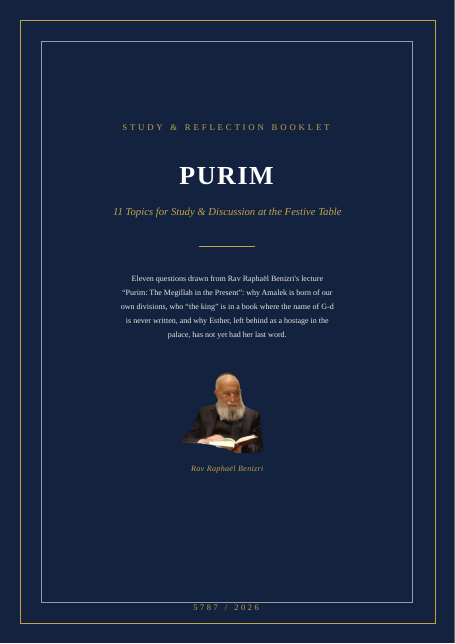
Amalek born of our divisions, the providence hidden behind the word “haMelech,” and Esther’s mission left unfinished. Watch the lecture and read the transcript →
Study booklets for each lecture: questions to reflect on as a family
The Book of Esther has a peculiarity that long troubled its readers: the name of G-d does not appear in it even once. Throughout the whole story there are only capricious kings, ambitious ministers, coincidences, a queen who finds favor, a man who refuses to bow, and a sleepless night.
A Story of Coincidences
Except that the coincidences pile up all too neatly. The king cannot sleep on precisely that night; he is read precisely the passage in which Mordechai had saved his life; Haman walks in at precisely that moment. Nothing is supernatural, and everything fits together.
That is what the book is about. It does not describe a world without providence, but a world in which providence no longer shows itself — a world very much like our own. The very name of the festival, “the lots,” refers to Haman’s casting of lots: chance in its purest form, which in the end is itself reversed.
The Reversal
One word keeps recurring in the text: everything is turned upside down. The gallows prepared for Mordechai is used on Haman; the day chosen for extermination becomes the day of deliverance. Purim is the festival of reversal — of the idea that a completely deadlocked situation can suddenly flip, and that no decree is the final word.
The Masks
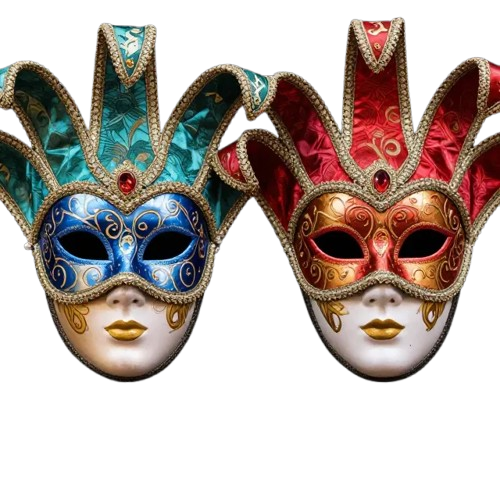
We dress up in disguise, and this is not mere entertainment for children. In a book where G-d hides, where Esther hides her origins, where a decree hides behind a casting of lots, the mask is the central theme made visible. What appears is not what is.
A Joy That Obligates
The festival requires four things: hearing the Megillah, having a proper festive meal, sending food to those close to us, and giving to those in need. Two of the four concern others. A joy that stayed at home would not be the joy of Purim.
Continue studying
Hanukkah, the other festival of deliverance, and Pesach, which follows a month later.
Read also: Why Do We Dress Up on Purim?