

Two interlocking triangles, six points, a center: the Star of David is today the best-known symbol of the Jewish people. You see it on the flag of Israel, on synagogues, on Israeli ambulances, and around the necks of thousands of people. But where does it come from? Is it in the Bible? Did King David really bear it on his shield? Here is a complete answer, one that separates what the texts say, what history shows and what tradition has read into it.
In short: the Star of David, in Hebrew Magen David (מָגֵן דָּוִד), literally means “shield of David.” The expression comes from Jewish liturgy, which calls G-d “the Shield of David,” echoing the promise made to King David (Talmud, Pesachim 117b). The six-pointed star itself, however, is mentioned neither in the Torah nor in the Talmud: it is an ancient motif, long purely decorative, which became the sign of the Jewish people only over a long history, from fourteenth-century Prague to the Zionist movement and the flag of Israel. It is not a mitzvah (a commandment), and the object has no holiness of its own. But its name carries a profound idea: it is G-d who protects His people, as He protected Avraham and David.
What does “Magen David” mean?
The Hebrew word magen means a shield, the defensive weapon a soldier holds in front of him. In the Bible it is very often applied to G-d Himself: He is the one who protects, not the weapon. The first use of this title is found in the promise made to Avraham: “Fear not, Avram, I am a shield to you” (Bereshit [Genesis] 15:1).
King David returns to this image again and again in his psalms. “But You, Hashem, are a shield about me” (Tehillim [Psalms] 3:4). “Hashem is my strength and my shield; in Him my heart trusted” (Tehillim 28:7). In his great song of victory he says again: “You have given me the shield of Your salvation” (Tehillim 18:36; Shmuel II [II Samuel] 22:36). For David, the true shield is not the metal he carries on his arm; it is G-d.
In its original sense, then, “Magen David” does not refer to a drawing. It is a title of G-d: “He who is the shield of David.” Only in the Middle Ages, and above all in modern times, did this name become attached to the six-pointed star. In English people say “Star of David”; in Yiddish you will hear “Mogen Dovid”; in Israeli Hebrew, “Magen David.”
What the Torah and the Talmud say
Let us say it plainly: no verse of the Torah and no page of the Talmud mentions the six-pointed star as a Jewish symbol. The Jewish symbols of antiquity are the menorah (the seven-branched candelabrum of the Temple), the shofar, the lulav and the etrog. These are what we find on the mosaics of ancient synagogues, on coins and on tombs.
On the other hand, the expression “Magen David” does appear in the Talmud, and that is where everything begins. The prophet Natan had conveyed this promise to David: “I will make you a great name, like the name of the great ones who are on the earth” (Shmuel II 7:9). The Talmud explains: “This is what we say: Magen David,” just as we say “Magen Avraham” (Pesachim 117b, teaching of Rav Yosef). In other words, the “great name” promised to David is that his name would be associated with G-d’s in prayer, like Avraham’s.
The same Talmudic passage specifies where this formula is said. The first blessing of the Amidah, the central prayer recited three times a day, concludes with “Baruch ata Hashem, Magen Avraham,” “Blessed are You, Hashem, shield of Avraham.” And the blessing recited after the haftarah, the reading from the Prophets on Shabbat and festivals, ends with “Baruch ata Hashem, Magen David,” “Blessed are You, Hashem, shield of David” (Pesachim 117b, teaching of Rabba bar Shila). This blessing asks for the return of the kingship of the house of David: “Let no stranger sit upon his throne.”
Every Shabbat, then, millions of Jews say the words “Magen David” in the synagogue without thinking of a star. They are speaking of G-d, who protected David and who guarantees the future of his dynasty, that of the Mashiach (the Messiah), a descendant of David.
A very ancient motif, long a mere decoration
The hexagram, the geometric figure formed by two equilateral triangles superimposed in opposite directions, has been known in many civilizations since the Bronze Age, from Mesopotamia to India. It is not a Jewish invention, and originally it had no particular religious meaning.
Among Jews too it appears very early, but as an ornament. The oldest certain example is a seal from the seventh century BCE found in Sidon, bearing the name of one Yehoshua ben Asayahu. In the ancient synagogue of Capernaum, in the Galilee (around the third century), a stone frieze shows a six-pointed star next to a five-pointed star and other decorative motifs. Nothing suggests it was anything other than decoration.
In the Middle Ages the hexagram appears in many Hebrew Bible manuscripts. The most famous of them, the Leningrad Codex (copied in 1008, the oldest complete manuscript of the Hebrew Bible), contains pages decorated in the shape of a six-pointed star. Sometimes the notes of the Masoretes (the scholars who fixed the biblical text) are themselves written in the shape of a star. But the same motif is found, in the same period, on churches, mosques, royal seals and notaries’ signatures. It belongs to everyone.
In the Muslim world the same figure went by another name: the “Seal of Solomon.” Legend attributed to King Shlomo (Solomon), son of David, a ring that gave him power over demons. The Talmud does speak of this ring, but it places the Divine Name on it, not a star (Gittin 68a-b). For centuries the two expressions, “Seal of Solomon” and “Shield of David,” were used interchangeably for the six-pointed star and the five-pointed star.
How the star became the “Shield of David”
The shift from a liturgical title to a drawing happened slowly, along paths that the historian Gershom Scholem reconstructed in a famous study of the history of this symbol.
Some esoteric writings of the Middle Ages spoke of a “shield of David” said to have been engraved with Divine Names to protect the king in battle. These texts circulated in the form of amulets, in which the Names were sometimes arranged inside a six-pointed star. Little by little, the shape took on the name. The oldest known text that explicitly calls the hexagram “Magen David” is a kabbalistic work from the early fourteenth century, the Sefer Ha-Gevul, attributed to a grandson of the Ramban (Nachmanides).
Another tradition, reported later by Rabbi Yitzchak Arama (Spain, fifteenth century) in his Akedat Yitzchak, claimed on the contrary that David’s shield bore not a star but Psalm 67 arranged in the shape of a menorah. This “Psalm 67 menorah” can still be found today in many Sephardic prayer books. Proof that, for a long time, the question of what David “carried on his shield” had no single answer.
One important point must be added. Jewish law has always been wary of magical practices. The Rambam (Maimonides) sharply criticizes those who added names of angels or protective signs to the mezuzah, because they turned a mitzvah, meant to recall the unity of G-d and the love we owe Him, into a mere talisman (Mishneh Torah, Hilkhot Tefillin uMezuzah veSefer Torah 5:4). Yet between the tenth and fourteenth centuries, many “magical” mezuzot bore precisely six-pointed stars. So the star was not, originally, an official religious symbol: it gained acceptance by other routes.
Prague, the first community with the star
It was in Prague that the Star of David first became the official emblem of a Jewish community. In 1354 the King of Bohemia, Charles IV (crowned emperor the following year), granted the Jews of Prague the privilege of having their own flag. This flag, later called the “flag of King David” in documents, bears a large six-pointed star. A flag of this kind, from a later period, can still be seen today in Prague’s Altneuschul (Old-New Synagogue).
From there the star spread through the Prague community: on synagogues, on the official seal, on printed books. The printer Gershom Kohen and his successors used it in the sixteenth century as a printer’s mark. The Foa family of printers, in Italy and later in Holland, incorporated it into their coat of arms.
From Prague the symbol reached Moravia and Austria. The Vienna community used it on its seal in 1655. When the Jews were expelled from Vienna in 1670, they took the emblem with them to their new communities; in Amsterdam the Ashkenazi community used it as early as 1671, first on a medallion granting access to the cemetery. But for a long time it remained a regional custom. In Eastern Europe, as in the communities of North Africa and the Middle East, it appears only occasionally, as an ornament.
The nineteenth century: a symbol for the whole Jewish people
It was in the nineteenth century that the Star of David became the universal sign of Judaism. At the time of emancipation, the Jews of Western Europe built large synagogues in city centers and looked for a simple, visible sign to identify them, as the cross identifies churches. The star, already known in Prague and Vienna, then won out: on façades, stained-glass windows, ritual objects, and the seals of communities and associations.
In 1822 the Rothschild family, ennobled by the Emperor of Austria, put the star on its coat of arms. From 1840 the poet Heinrich Heine signed his dispatches from Paris for the Augsburger Allgemeine Zeitung with a Star of David instead of his name. In the second half of the century the symbol spread to almost every community in Europe, and then beyond.
The flag of Israel and the Holocaust
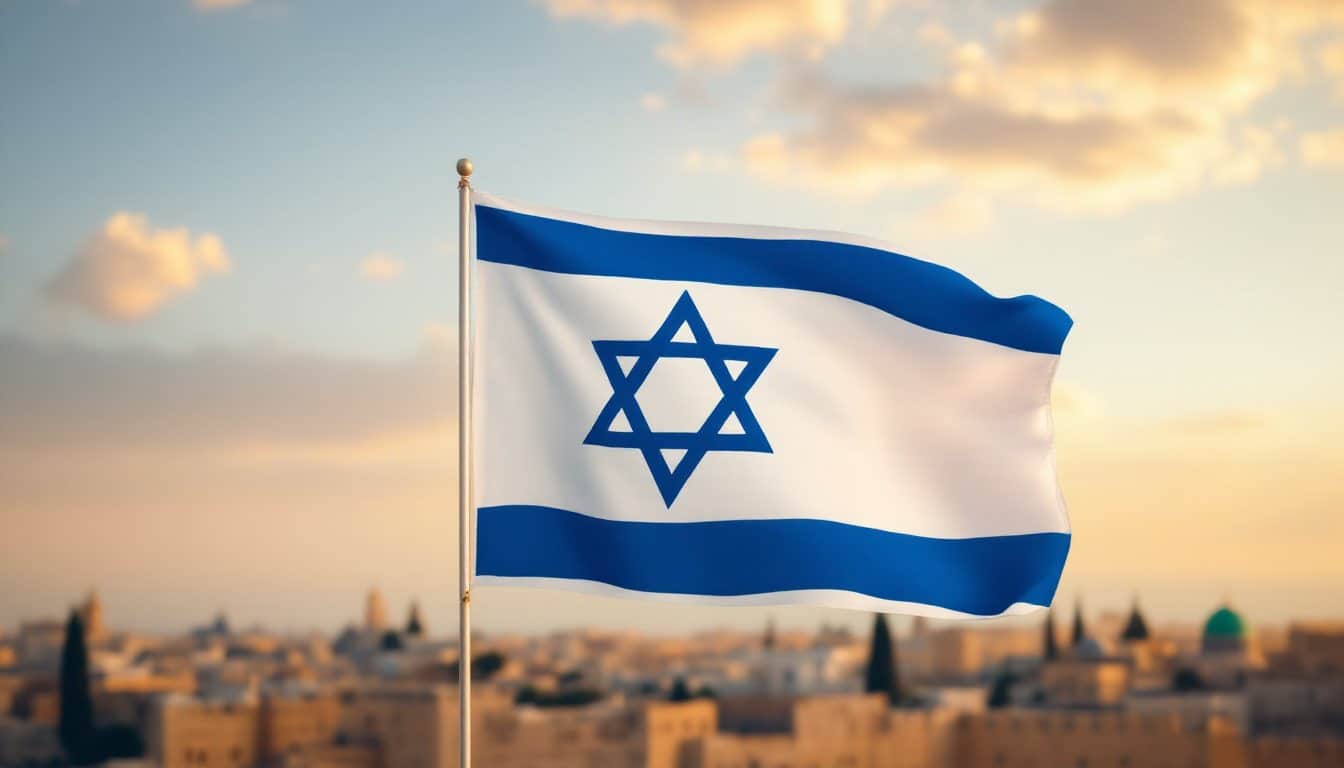
In 1897 Theodor Herzl convened the First Zionist Congress in Basel. His newspaper, Die Welt, bore the Star of David from its very first issue. The flag adopted by the Zionist movement is white, with two blue stripes inspired by the tallit (the prayer shawl) and a Star of David in the center. On 28 October 1948, a few months after its founding, the State of Israel made it its national flag. For its coat of arms, however, the State chose the menorah, a far older biblical symbol.
In the meantime the star had taken on a tragic dimension. The Nazis forced Jews to wear a distinguishing sign in the shape of a Star of David: first in occupied Poland from the end of 1939 (often a white armband with a blue star), then in Germany in September 1941, with the yellow star marked with the word “Jude” (“Jew”). In occupied France the yellow star became compulsory from 7 June 1942 for all Jews aged six and over (German ordinance of 29 May 1942). The sign of G-d’s protection had become, in the hands of the persecutors, a mark of exclusion and the prelude to deportation.
The survivors and the Jewish people refused to let their tormentors have the last word. The philosopher Franz Rosenzweig had already given his great book the title The Star of Redemption (1921), making the six-pointed star the image of the relationship between G-d, man and the world. After the Holocaust, the star raised on the flag of Israel became the sign of a people rising again, like King David, who had come through so many trials.
The star also appears on the emblem of Magen David Adom, the “Red Shield of David,” Israel’s national emergency medical service, founded in 1930. For decades it was not admitted into the International Red Cross and Red Crescent Movement, which recognized only the red cross and the red crescent. It was admitted only in 2006, after the adoption of a third, neutral emblem, the red crystal (2005 protocol).
What the star evokes: explanations from the tradition
Because the star has no source in the Torah, its “explanations” are not laws but readings. They are nonetheless beautiful and instructive, and many Jews have made them their own.
The shield that protects. The first explanation is that of the name itself. Magen David is a reminder that the strength of the Jewish people does not come from its weapons. David defeated Goliath by telling him: “You come to me with a sword, a spear and a javelin; but I come to you in the name of the L-rd of hosts” (Shmuel I [I Samuel] 17:45). To bear a “shield of David” is to declare that protection comes from above.
Heaven and earth. The two triangles point one upward and the other downward. Many see in this the image of the meeting between man rising toward G-d and G-d descending toward man, between the spiritual and the material. Judaism does not flee the world: it seeks to bring holiness down into concrete life.
Six directions and a center. The star has six points: up, down, and the four directions of the horizon. Its center makes seven. This number is often linked to the six days of creation, directed toward the seventh, Shabbat, which gives meaning to the whole week. G-d is present in every direction, and the center is the point where man stands before Him.
The kabbalistic reading. In Kabbalah, Jewish mysticism, G-d manifests Himself in the world through ten “attributes,” the sefirot. Six of them, from kindness (chesed) to foundation (yesod), are often represented by the six points of the star; the seventh, kingship (malkhut), is its center. And the Zohar specifically associates King David with malkhut, kingship. It has often been noted that the Passover Seder plate, as arranged by the great kabbalist of Safed Rabbi Yitzchak Luria, the Arizal (sixteenth century), places the six foods in two superimposed triangles, the plate itself representing malkhut.
David, the king who unites. Finally, David is the one who united the tribes of Israel, made Jerusalem his capital and prepared the building of the Temple. The two interlocking, inseparable triangles also speak of the unity of a people whose members are bound to one another.
What Rav Raphaël Benizri teaches
Rav Benizri has not devoted a lecture to the Star of David itself. But in a lecture on Bereshit Rabbah he discusses the title of “shield” that tradition gives to Avraham and to David, which sheds light on the original meaning of the expression Magen David.
In Bereshit Rabbah 39, part 6: goy gadol, the Rav observes that the Torah tells us almost nothing about Avraham’s religious quest. We know that he would teach his children justice and charity, and that he received the commandment of mila, circumcision. Beyond that, his path comes down to taking possession of the land and founding a nation. Avraham, the Rav explains, laid the foundations for possessing the promised land and for a national home, and it was David who completed this path through conquest.
The Rav then points out a link: Magen Avraham and Magen David. These, he says, are the only two to bear this title of shield, through which the protection of Hashem is recognized: the divine providence that led Avraham on the road to the promised land, and the providence that allowed David to complete that road.
In the same lecture, the Rav cites the midrash according to which G-d told Avraham that his blessing would precede His own: the blessing “Magen Avraham” comes in the Amidah before the one that speaks of the resurrection of the dead, because Avraham went out to meet G-d and proclaimed His Name everywhere. One can take from this that the “shield” is not merely an object of protection: it is bound up with a mission, that of making G-d’s Name known in the world.
Read in this light, the Magen David is not, first and foremost, a star but a promise: the one that links the first of the patriarchs to the king who founded Jerusalem, and, through him, to the Mashiach son of David.
Misconceptions about the Star of David
“The Star of David is a religious commandment.” No. It is not a mitzvah, and no law requires anyone to wear or display it. It does not have the holiness of a Torah scroll, tefillin or a mezuzah.
“King David bore this star on his shield.” It is a lovely legend, but no biblical or Talmudic source says so. The Talmud speaks of G-d as the “shield of David,” not of a drawing.
“It is the oldest Jewish symbol.” No. The oldest distinctly Jewish symbol is the menorah, attested from antiquity. The star became an official Jewish emblem only in the fourteenth century in Prague, and a universal one in the nineteenth century.
“The star is an occult or Masonic symbol.” The hexagram has been used in many cultures, including in magic and alchemy, like many other geometric shapes. But for Jews, for centuries, it has simply meant belonging to the people of Israel and trust in G-d.
“The flag of Israel represents a religion.” The flag represents the State and the people. Its blue stripes recall the tallit, and its star takes up the emblem adopted by the Zionist movement in 1897.
Frequently asked questions about the Star of David
What does “Magen David” mean?
Magen David means “shield of David.” It is first of all a title of G-d, which concludes the blessing recited after the reading from the Prophets in the synagogue (Pesachim 117b). Since the Middle Ages this name has also referred to the six-pointed star.
Why does the Star of David have six points?
That is the shape of the hexagram, two triangles superimposed in opposite directions, a motif known in many cultures. Tradition has read several meanings into it: the six directions of space around a center, the six days of creation directed toward Shabbat, or, in Kabbalah, six divine attributes gathered around kingship, which is associated with David.
Does the Bible mention the Star of David?
No. Neither the Torah, nor the Prophets, nor the Talmud mentions the six-pointed star as a Jewish symbol. The Bible often speaks of G-d as a “shield” (Bereshit 15:1; Tehillim 3:4), and that is where the name comes from.
Can a non-Jew wear a Star of David?
Nothing forbids it, since it is not a holy object. But because the star is seen today as the sign of Jewish identity, wearing it amounts to presenting oneself as Jewish or as close to the Jewish people. Everyone will judge for themselves what meaning they give to this gesture.
Can you go into a bathroom wearing a Star of David pendant?
Yes. The star has no holiness and bears no Divine Name; it is not subject to the rules that govern holy objects. If a piece of jewelry bore verses or Divine Names, the question would be different, and one should consult a rabbi.
What is the difference between the Star of David and the menorah?
The menorah is the seven-branched candelabrum of the Temple, described in the Torah (Shemot [Exodus] 25:31-40): it is the oldest Jewish symbol and the official emblem of the State of Israel. The Star of David is a more recent symbol, which became popular in the nineteenth century and appears on the flag of Israel.
Why the yellow star?
The Nazis forced Jews to wear a yellow star in order to mark them, exclude them and then deport them. They hijacked the symbol of a people and turned it into a sign of humiliation. By taking it up again on their flag, the Jews restored its dignity.
Further reading
The Star of David took centuries to become the face of the Jewish people. But its name comes from the heart of prayer: every Shabbat, we thank G-d for being the shield of David. Behind the drawing lies trust.
- Bereshit Rabbah 39, part 6: goy gadol
- Lech Lecha: Avraham’s journey
- The 3 Patriarchs: Avraham, Yitzchak and Yaakov
- Tetzaveh: elevating oneself (the menorah of the Sanctuary)
- What does “chosen people” mean in Judaism?
- The Messiah in Judaism
- What is a synagogue?
- Glossary of Hebrew terms in Judaism
Sources and references
- Bereshit (Genesis) 15:1
- Shemot (Exodus) 25:31-40
- Shmuel I (I Samuel) 17:45
- Shmuel II (II Samuel) 7:9
- Shmuel II (II Samuel) 22:36
- Tehillim (Psalms) 3:4
- Tehillim (Psalms) 18:36
- Tehillim (Psalms) 28:7
- Tehillim (Psalms) 67
- Babylonian Talmud, Pesachim 117b (Rav Yosef; Rabba bar Shila)
- Babylonian Talmud, Gittin 68a-b
- Blessings after the haftarah (“Magen David”), siddur
- Rambam, Mishneh Torah, Hilkhot Tefillin uMezuzah veSefer Torah 5:4
- Sefer Ha-Gevul (early fourteenth century)
- Rabbi Yitzchak Arama, Akedat Yitzchak
- Arrangement of the Seder plate according to the Arizal (Rabbi Yitzchak Luria)
- Gershom Scholem, “The Magen David: the history of a symbol”, 1949 (reprinted in The Messianic Idea in Judaism, 1971)
- Encyclopaedia Judaica, article “Magen David”
- Franz Rosenzweig, The Star of Redemption, 1921
- Seal of Yehoshua ben Asayahu, Sidon, seventh century BCE
- Frieze of the Capernaum synagogue (around the third century)
- Leningrad Codex (1008)
- Privilege granted by Charles IV to the Jewish community of Prague, 1354
- German ordinance of 29 May 1942 imposing the yellow star in the occupied zone (France), in force from 7 June 1942
- Third Additional Protocol to the Geneva Conventions (2005); admission of Magen David Adom (2006)
- Rav Raphaël Benizri, Bereshit Rabbah 39, part 6: goy gadol
Article by the Pensées Juives editorial team. Passages attributed to Rav Raphaël Benizri are taken from his lectures published on this site.