
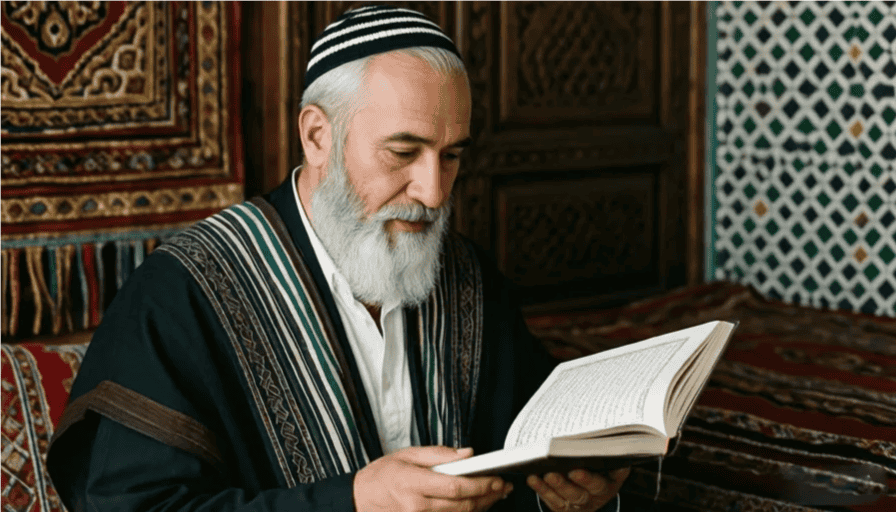
Torah study holds a central place in Jewish life. It is regarded not only as a religious duty, but as a way of entering into a direct relationship with the Divine. In Jewish tradition, the Torah is not merely a sacred text: it is the source of wisdom, of moral meaning and of the spiritual continuity of the people of Israel. The study of its teachings — whether the Tanakh, the Mishnah or the Talmud — is seen as a sacred act, one that can elevate the soul and strengthen the bonds of the community.
The Sages teach that Torah study is equal to all the other commandments, for it enlightens the mind and guides action. It is not reserved for an intellectual elite; it is a collective mission: every Jew, man or woman, young or old, is invited to engage in it according to his or her abilities. It is through this constant practice that Judaism has preserved its identity and its vitality across the centuries and the exiles.
The Scholarship of the Moroccan Jewish Sages
In Morocco, Torah study took on rich and profound forms, marked by spiritual fervor and intellectual precision. Ancient communities such as those of Fez, Meknes, Marrakesh, Tetouan and Essaouira produced, generation after generation, scholars respected throughout the Sephardic world.
Figures such as Rabbi Chaim Pinto of Essaouira, Rabbi Yaakov Abuhatzeira (the grandfather of the Baba Sali) and Rabbi Yosef Messas embodied this fusion of piety, wisdom and openness. Their writings — biblical commentaries, halachic rulings (responsa) and mystical works — nourished a tradition of study in which Talmudic rigor and popular fervor lived side by side in harmony.
The Moroccan yeshivot — schools of religious study — were vibrant centers of learning. There, students learned not only Torah and Talmud, but also Hebrew grammar, liturgical poetry (piyyutim) and at times even medieval Jewish philosophy in the tradition of Maimonides. This knowledge was handed down with humility, in a spirit of mesorah (the chain of transmission) that bound the generations together.
Heritage and Continuity
Even after the mass emigration of Moroccan Jews in the twentieth century, this intellectual and spiritual heritage lives on in the Moroccan communities of France, Israel and Canada. The spirit of study, the warmth of community life and reverence for the sages remain at the heart of this Sephardic identity, faithful to the ancestral ideal: “Study leads to action” (Talmud Bavli, Kiddushin 40b).
The love of Torah, passed down from father to son and from teacher to student, is the cornerstone of a culture in which knowledge is sanctified and wisdom is shared. Moroccan scholarship is thus not merely a memory of the past, but a living light that continues to illuminate the Jewish world today.